Nevada Provides the Setting, the New PEA the Numbers
When geopolitical tensions, inflation concerns and sharp price swings shake financial markets, gold attracts greater attention as a potential anchor of stability. Yet alongside the precious metal price, what matters most is which companies can turn their resources into economically viable mines. Lahontan Gold Corp. (ISIN: CA50732M1014 | TSX-V: LG | FRA: Y2F | WKN: A3DKKY) offers a notable example, with a new economic assessment of the Santa Fe project in Nevada. The state is an established US mining region, and Lahontan has a portfolio of four gold and silver projects in the mineral-rich Walker Lane area. The historic Santa Fe mine produced 359,202 ounces of gold and 702,067 ounces of silver between 1988 and 1995. Today, the project reports resources of around 2.39 million ounces of gold equivalent, split between the Indicated and Inferred categories. With the Preliminary Economic Assessment (PEA) published on October 14, the story now goes beyond resource figures: for the first time, an updated overall economic assessment is available that gives concrete shape to the potential for a restart.
Emergent Acquisition: Consolidated Rights and Additional Assets
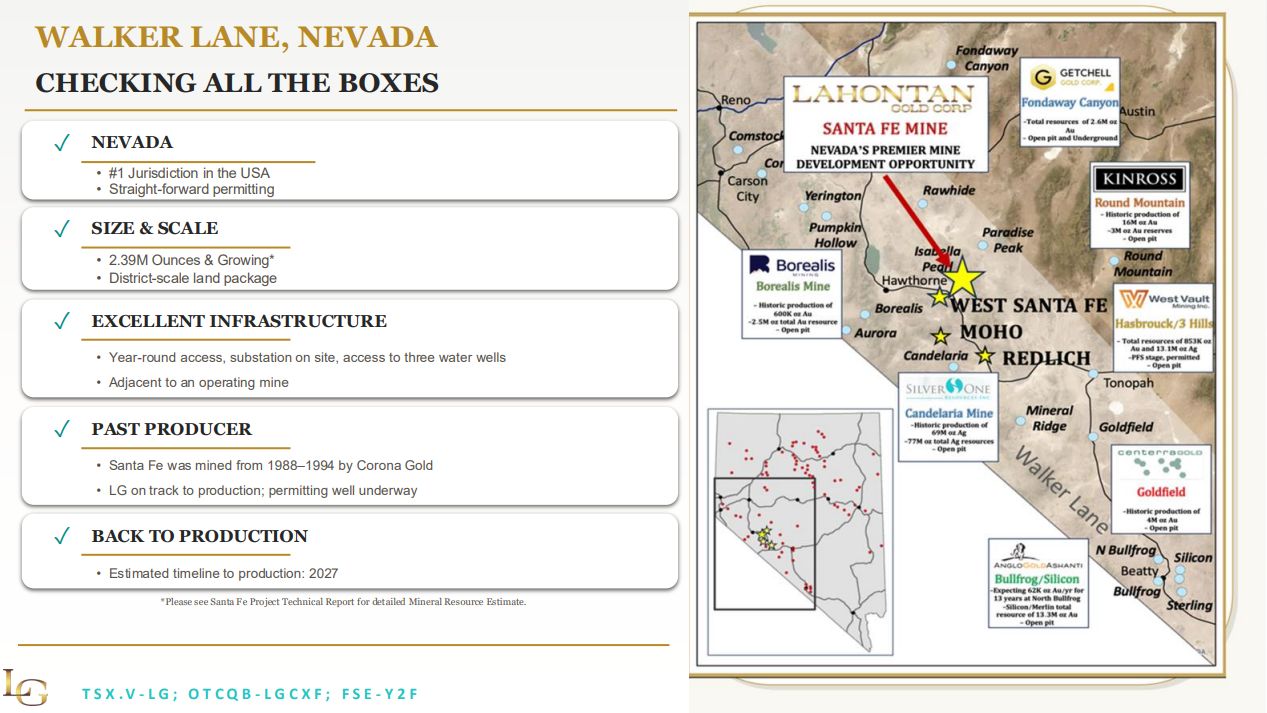
With the planned merger with Emergent Metals, Lahontan Gold aims to strengthen its position in the Walker Lane on several levels at once. The transaction, agreed on September 15, 2026, is intended to secure full control of West Santa Fe while eliminating previously envisaged payments of around CAD 2.39 million to acquire the remaining project interest. There is also an economically significant benefit: the 1% net smelter return royalties on West Santa Fe and 27 claims at York are to be eliminated, reducing the burden on potential future revenues. In addition, the portfolio will expand to include the adjacent New York Canyon project, which offers geological potential for copper, gold, silver and molybdenum. Emergent also brings interesting financial assets: a USD 3.5 million receivable from Fairchild Gold, 12.5 million Fairchild shares, and a royalty interest in the Golden Arrow project. Upon completion, Lahontan would control a land package of more than 93 km² in Nevada's Walker Lane while gaining additional options for future value realisation. The real leverage therefore lies in the combination of more complete project control, the elimination of certain royalty obligations and additional financial and geological opportunities. However, the deal is not yet complete: it remains subject to the necessary shareholder, court and stock exchange approvals.
The New PEA: USD 820 Million After-Tax NPV and an 11-Year Mine Life
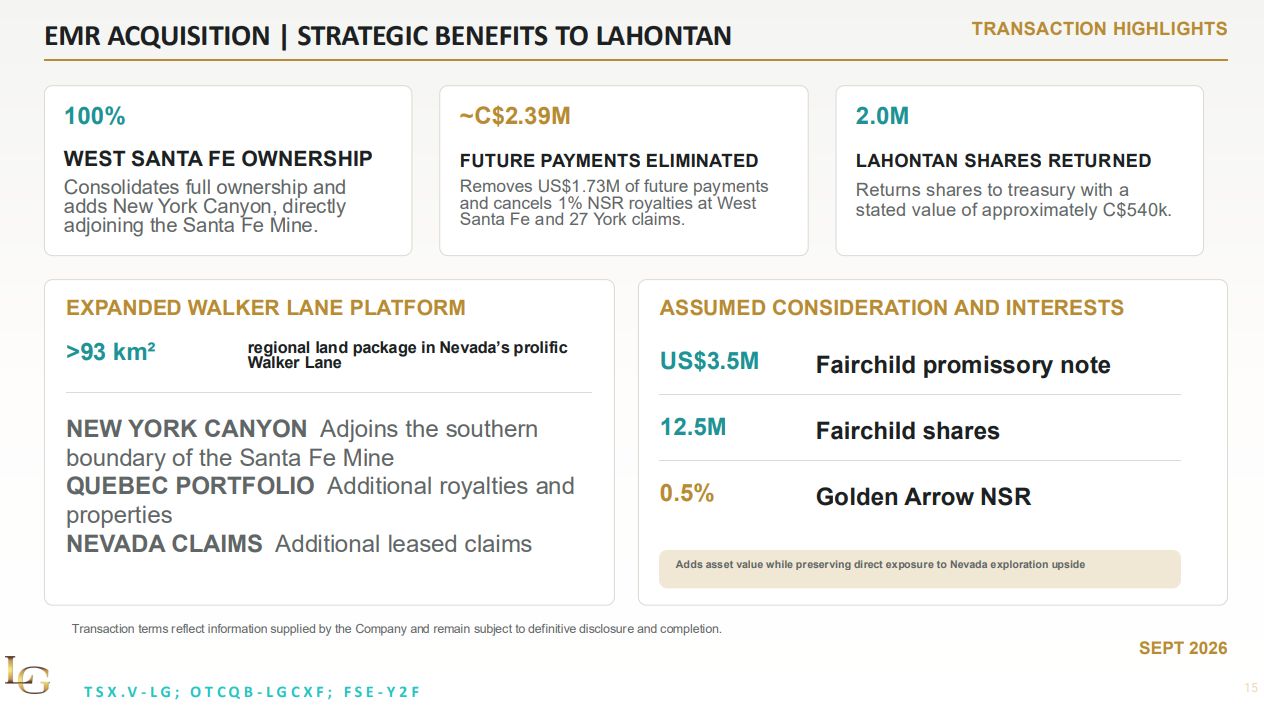
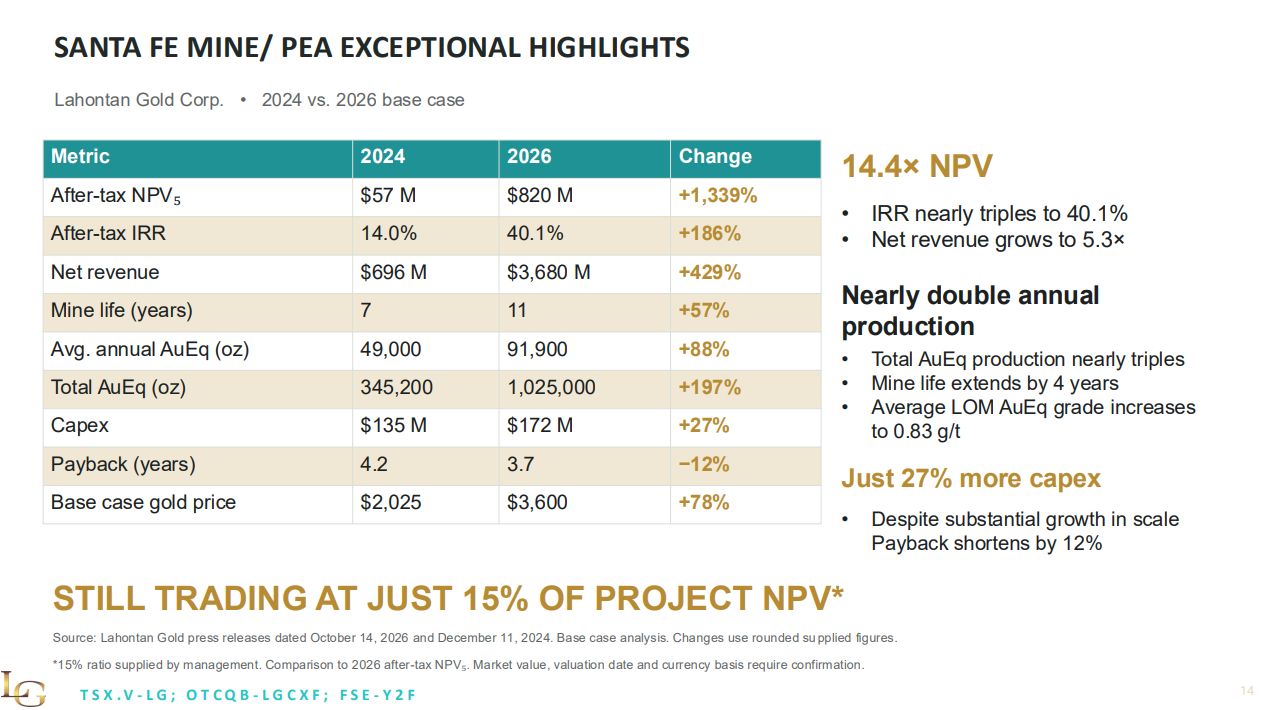
The key figure is striking: the new PEA puts the after-tax net present value (NPV) at a 5% discount rate at USD 820 million and the internal rate of return (IRR) at 40.1%. This is based on base-case prices of USD 3,600 per ounce of gold and USD 49 per ounce of silver. The calculated NPV thus increases by more than fourteenfold compared with the 2024 study, which reported just USD 56.5 million. The mine plan envisages 11 years of active operations followed by residual leaching. Over the mine life, the mine is expected to generate around USD 3.68 billion in revenue and approximately USD 1.32 billion in after-tax net cash flow. Average annual production is estimated at around 91,900 ounces of gold equivalent and is expected to rise to an average of around 112,500 ounces between the fourth and eleventh years of operation. In four years, the mine plan shows production of more than 120,000 ounces of gold equivalent. Estimated cash costs are USD 1,909 per ounce of gold, with all-in sustaining costs (AISC) at USD 2,250. However, these should fall in the foreseeable future once operations are running smoothly. For the construction phase, the study estimates USD 172 million in pre-production capital. The payback period is estimated at around 3.7 years in the base case, falling accordingly at higher gold prices. All figures include a 20 percent contingency. These ambitious modelled figures clearly move Santa Fe into a new economic league, but they are entirely achievable based on the underlying metal prices, cost assumptions and technical plans.
Higher Gold Prices Offer Additional Upside Potential – But the Assumptions Matter
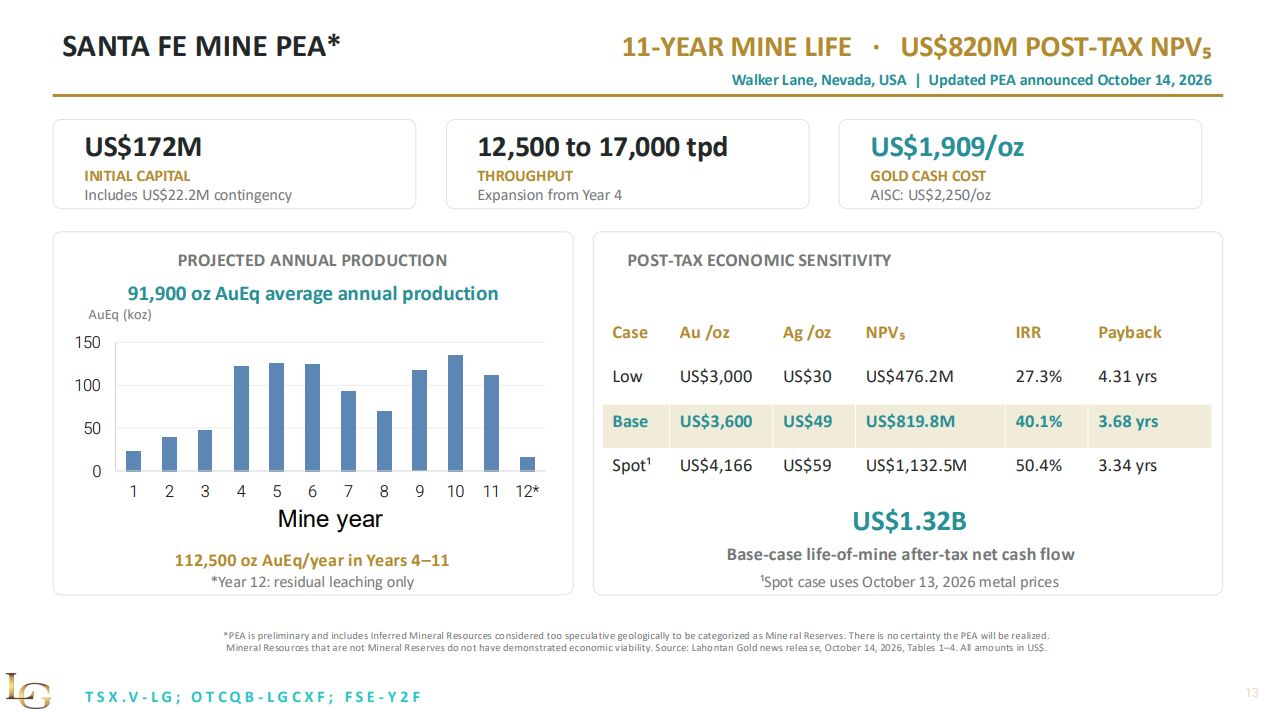
The sensitivity analysis shows how strongly the project responds to changes in precious metal prices. In the case described by Lahontan as the spot scenario, with gold at USD 4,166 and silver at USD 59, the after-tax NPV rises to around USD 1.13 billion, while the IRR reaches 50.4%. Even the lower scenario, with gold at USD 3,000 and silver at USD 30, still yields an after-tax NPV of around USD 476 million and an IRR of 27.3%, according to the PEA. For the broader Santa Fe outlook, the mine plan also needs to combine material from the Santa Fe, Calvada, Slab and York deposits and use conventional open-pit mining and heap leaching. Processing is initially expected to cover around 4.6 million tonnes annually, later rising to approximately 6.2 million tonnes. Additional opportunities could arise from further drilling, a potential extension of the known mineralisation and the investigation of historic leach pads.
West Santa Fe also remains a potential additional growth driver as a satellite project, but must be distinguished from the results already calculated in the Santa Fe PEA. Context is crucial: A PEA is a preliminary economic assessment and not a feasibility study. It also includes inferred resources whose economic viability has not yet been sufficiently established. Lahontan has not yet defined any mineral reserves for Santa Fe, and the calculated metrics do not guarantee subsequent implementation. Nevertheless, investors gain a good indication of where things could be heading in the future.
Conclusion: From Gold Project to a Credible Development Story
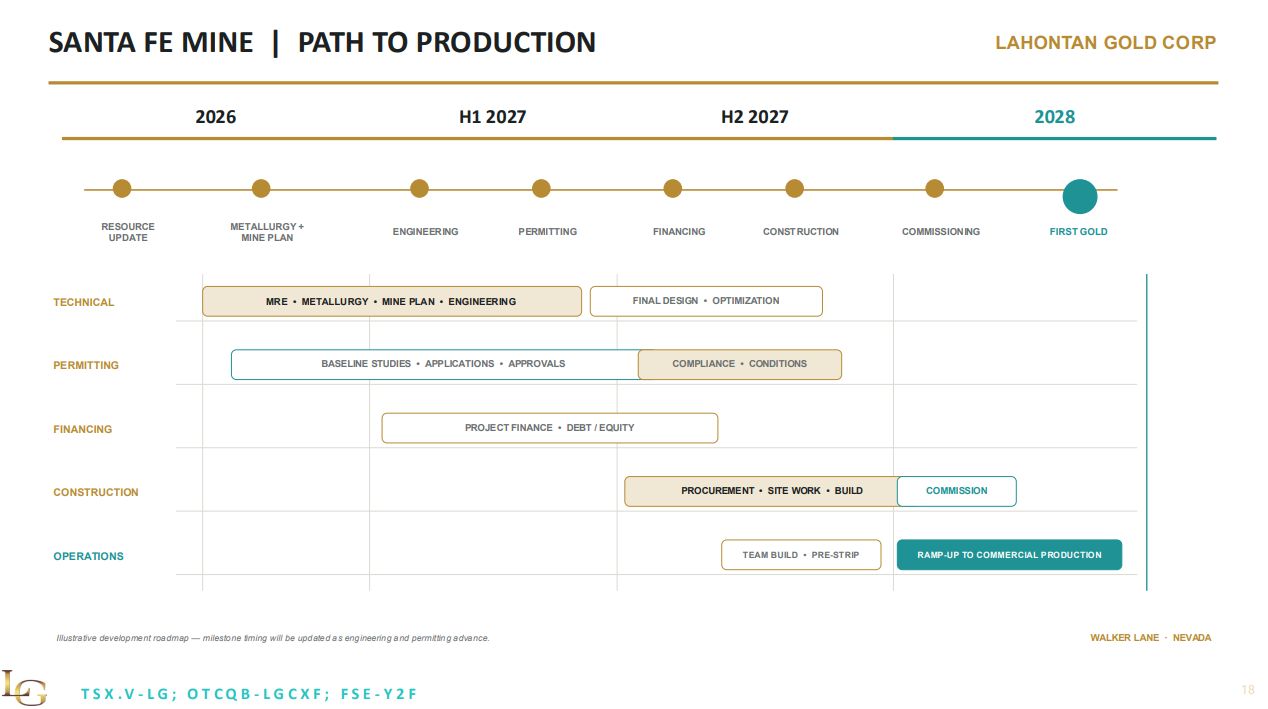
With the new PEA, Lahontan now has a much more concrete economic outlook for the planned restart of Santa Fe. A modelled after-tax NPV of USD 820 million, a double-digit mine life and planned annual production of close to 92,000 ounces of gold equivalent provide strong key metrics for further project development. At the same time, the more demanding phase begins: the company must technically validate the planning assumptions, secure permits, and arrange financing for the estimated initial capital expenditure of USD 172 million. Lahontan expects to receive the necessary federal and state permits for mine construction in 2027, with the environmental baseline studies already completed. The timetable nevertheless remains ambitious and depends on regulatory decisions, financing and implementation. For investors, the attraction now lies in Santa Fe no longer being defined solely by its geological potential, but by a comprehensive, preliminary economic assessment.
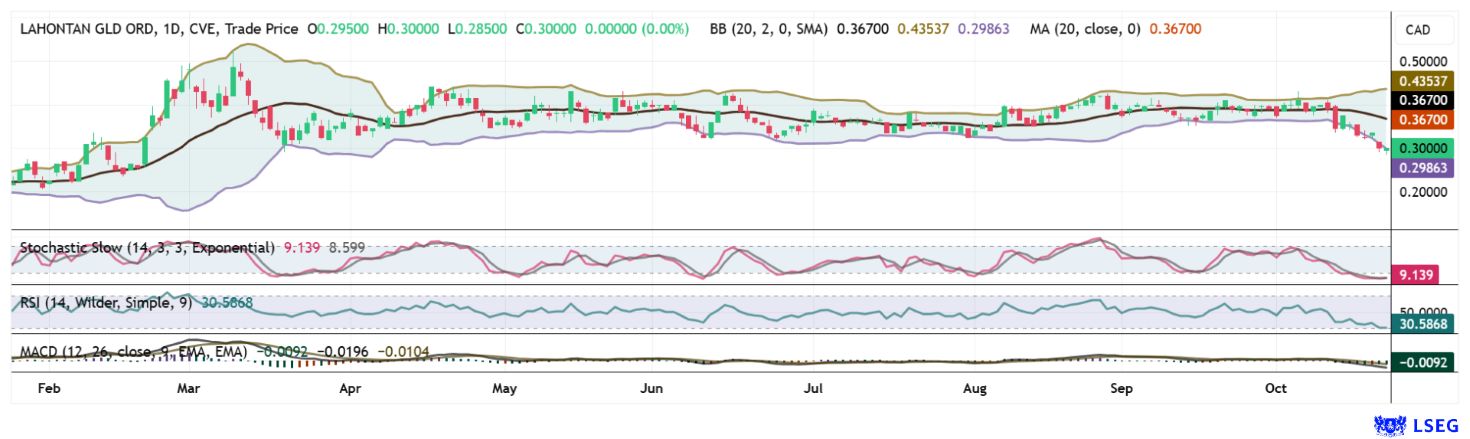
Lahontan Gold's chart came under pressure amid the broader market and precious metals correction. In the general sell-off, investors appear to have overlooked the strong PEA figures. For new investors and those looking to add to existing positions, the oversold technical indicators now offer a discounted entry point. After all, the project value has increased fortyfold since 2024, while the market capitalisation has fallen to CAD 125 million. You do not see that every day!
IIF host Lyndsay Malchuk interviews CEO and founder Kimberly Ann about the next steps in Nevada.
This update follows our Initial Report on Lahontan Gold from April 2026. Click here for the analysis and another update dated 12.10.2026.