
The Tungsten Market Is Becoming a Geopolitical Minefield
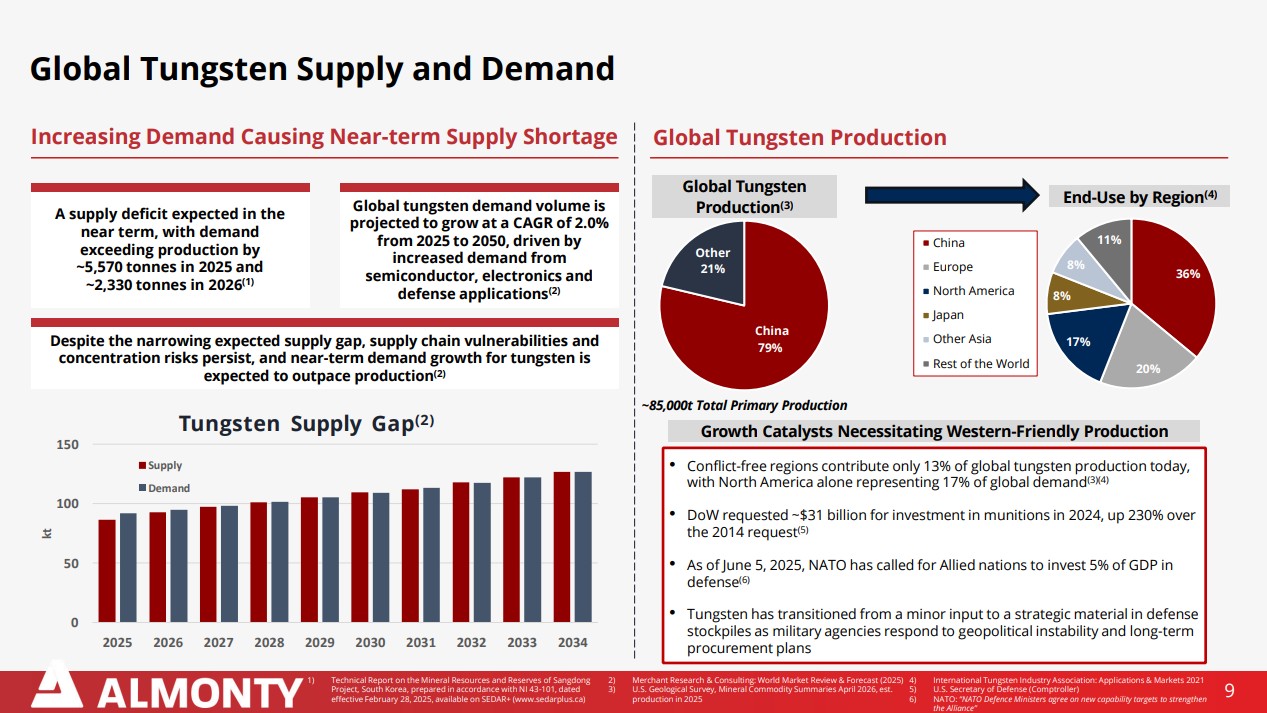
Tungsten is evolving from a specialty metal into a strategic power factor. This extremely hard and heat-resistant metal is required for applications including cemented carbides, cutting tools, electronics, industrial uses, and defense systems, giving it significance that extends far beyond traditional commodity markets. At the same time, the global supply is exceptionally concentrated in China. It is precisely this dependence that is increasingly becoming a problem for Western nations, as export restrictions and an aggressive raw materials policy heighten the risk that industrial and military supply chains will come under pressure in the event of a crisis.
For Almonty, this creates a structural tailwind that extends far beyond a typical commodity cycle. Those capable of producing tungsten outside of China are supplying not merely a metal, but a building block for industrial and military supply security. The importance of conflict-free supply sources is therefore increasing in parallel with geopolitical tensions. With Sangdong in South Korea, Panasqueira in Portugal, and projects in the US and Spain, Almonty possesses precisely the geographic diversification that Western customers are likely to need in the future.
Sangdong Transforms from a Future Project to a Producer
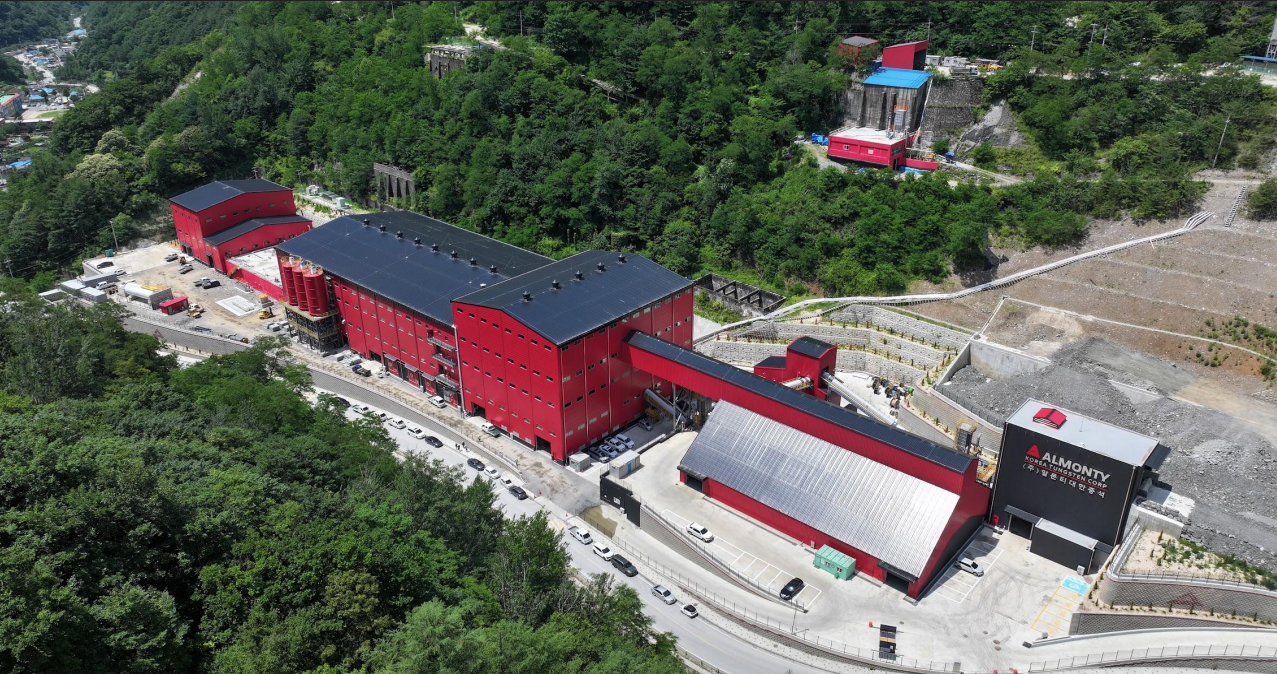
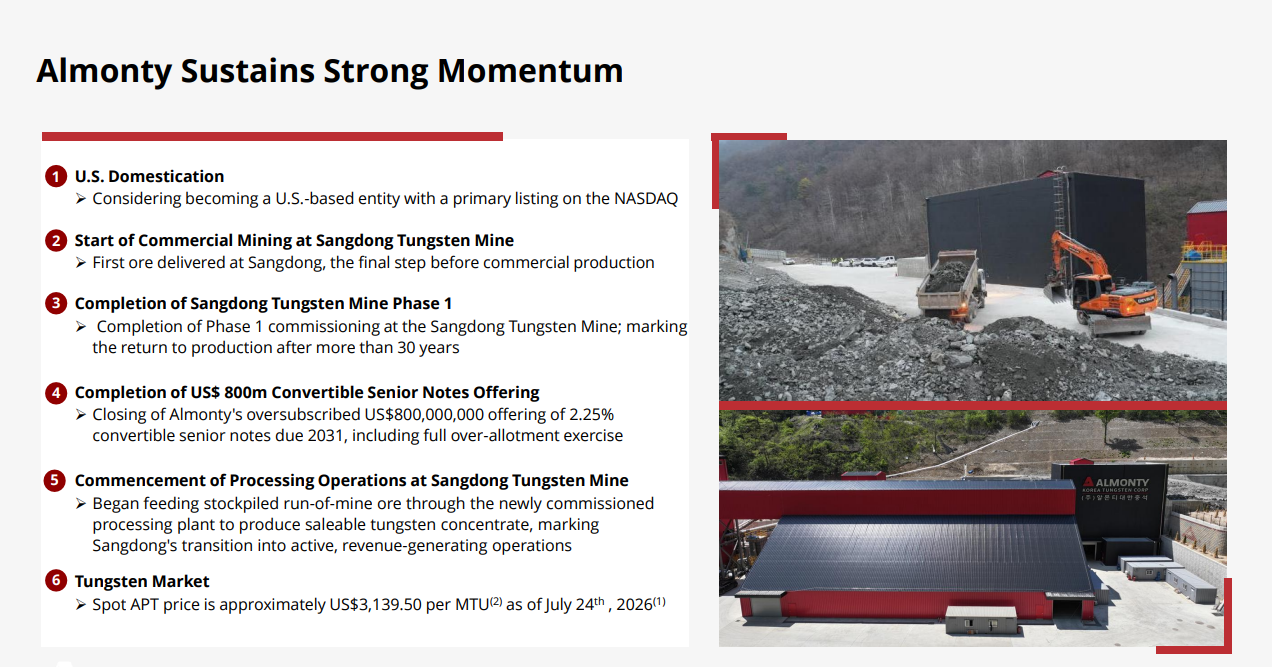
The decisive switch has been flipped in Sangdong. With the commissioning of the processing plant in early July, the mined ore began to be processed into marketable tungsten concentrate. Thus, after more than a decade of development work, Almonty has taken what is perhaps the most important step in its corporate history: the major South Korean project is no longer confined to construction and development plans but is moving toward commercial production.
An ore stockpile of approximately 139,700 metric tons, with an average grade of about 0.25% WO₃, is available for the controlled ramp-up. This stockpile is sufficient for approximately 2.6 months of the initial production phase and, based on the metal content, has a calculated value of around USD 68 million. The quality of the start-up material is particularly interesting: even the lower ore grade initially used is approximately three times higher than the average material at the Panasqueira mine in Portugal. Management is deliberately using the start-up phase to optimize processing, blending ratios, and output before higher-grade areas are incorporated more heavily into the production mix.
Montana: Gentung Could Become the American Tungsten Wild Card
Following the start of production in South Korea, the US platform is gaining increasing strategic importance. Almonty's Gentung project is located in the US state of Montana within a historic tungsten mining district and borders directly on Red Mountain Mining's Pioneer Tungsten Project. It is precisely there that new exploration results are currently attracting additional attention. Red Mountain is conducting systematic rock sampling in the Greenstone and Lost Creek areas. Initial analyses yielded peak values of 3,159 ppm (0.32% WO₃) at Greenstone and 2,856 ppm (0.29% WO₃) at Mammoth. These values are remarkably close to the grades of Almonty's neighboring Gentung deposit, which holds a substantial resource of 6.83 million metric tons at 0.315% WO₃. Should the ongoing investigations confirm corresponding spatial continuity, this could lead to drill targets and further development steps. The geology is particularly interesting because tungsten-bearing garnet skarns occur along the contact between granodiorite and calcareous rocks. This gives Gentung additional strategic value. Almonty could potentially integrate not only South Korean but also US tungsten into the Western supply chain.
21 Years of Revenue Visibility: GTP Becomes a Strategic Anchor
Even more compelling than short-term price trends is the long-term hedging of Sangdong's revenues. Almonty has significantly upgraded its offtake agreement with Global Tungsten & Powders, a company within the Austrian Plansee Group. The contract term has been extended by 6 years to a total of 21 years, while the agreed-upon supply volume has increased by 40% to 4.41 million MTU. In addition, the price basis for the contractually agreed-upon volumes has improved by approximately 6.3%. Based on current APT prices, this results in an expected annual contract revenue of approximately USD 490 million. The improved terms alone could generate additional revenue of about USD 30 million per year, or roughly USD 630 million over the entire term, compared to the previous agreement. The real highlight, however, lies in the expansion that has not yet been priced in. The contract covers approximately 90% of Phase I production in Sangdong. The planned Phase II, further production increases in Portugal, and potential contributions from the US projects are not included in this figure. Almonty thus already has a long-term secured revenue base and, at the same time, significant volumes that can be marketed additionally in the future.
Initial Figures Show Enormous Operational Leverage
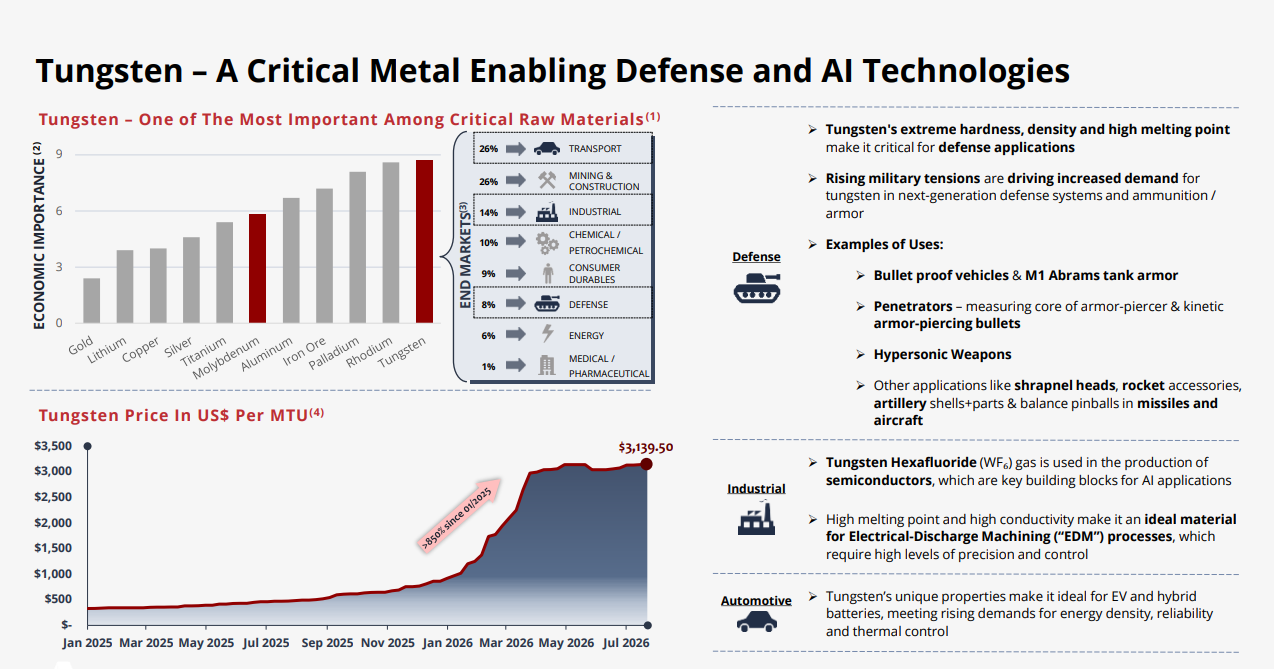
Just how strong this leverage can be is already evident from the figures for the second quarter of 2026—even though Sangdong had not yet reached full production at that time. Between April and June, Almonty generated revenue of CAD 43.0 million, representing a 498% increase compared to the same quarter of the previous year. Compared to the first quarter, this represented a further increase of 69%. At the same time, earnings from mining operations improved to CAD 26.1 million, whereas a loss of CAD 0.9 million had been incurred in the same quarter of the previous year. Even more important for assessing operational quality is the adjusted EBITDA of CAD 17.6 million, compared to a loss of CAD 4.8 million a year earlier. Operating cash flow amounted to CAD 31.6 million in the first half of the year, following a cash outflow of CAD 14.9 million in the same period a year earlier. Even before Sangdong reaches full production, these figures illustrate just how sensitive profitability is to the price of tungsten. The European APT reference price averaged USD 3,075 per MTU in the second quarter, compared to just USD 453 per MTU a year earlier. However, the reported net income of CAD 181.8 million must be viewed in context. This figure included CAD 173.1 million in non-cash valuation effects from derivatives and warrants. For operational analysis, therefore, EBITDA, mining profit, and cash flow are significantly more meaningful. And it is precisely these metrics that show a clear improvement in the company's economic fundamentals.
Billions in Cash Instead of Financing Worries
In parallel with its operational transformation, Almonty has elevated its financial position to an entirely new level. The significantly oversubscribed convertible senior notes offering completed in June raised a gross total of USD 800 million. As of the end of June, the Group thus had approximately CAD 1.23 billion in cash and cash equivalents—compared to just CAD 268.4 million at the end of 2025. This capital strength significantly expands strategic opportunities. Almonty can now advance multiple projects simultaneously, rather than having to finance growth initiatives one after another. The agenda includes, among other things, the second expansion phase of Sangdong, a planned tungsten oxide plant in South Korea, the development of the Gentung project in Montana, and the expansion of Panasqueira. A company that has long relied on financing a single large-scale project is thus transforming into a group with a fully fledged growth pipeline and significant financial flexibility. In addition, Almonty fully repaid its KfW term loan after the end of the quarter.
Just One Listing Now Concentrates Liquidity: Almonty Joins the Russell Index
Almonty has also made significant strides on the stock market front. At the end of June, the stock was added to the Russell 1000 and Russell 3000. This brings the company into the spotlight of a much larger group of institutional investors and index-driven capital flows. In addition, Almonty is focusing its stock market presence more strongly on the US capital market and the Nasdaq. Already today, the vast majority of daily trading volume occurs on the US exchange, while a dual listing incurs additional administrative and compliance costs. By consolidating liquidity on a North American trading venue plus Germany, management expects more efficient capital market structures and even greater visibility among international investors. This move aligns with the company's strategic direction, as its most important growth driver—tungsten, a critical raw material for Western defense and technology supply chains—holds particular political significance in the US. The market is thus beginning to evaluate Almonty increasingly by different criteria. In the future, the decisive factors will no longer be just resources and exploration potential, but rather production capacity, contract volume, cash flow, balance sheet strength, and strategic scarcity premiums.
Almonty Is Now Capitalizing on Its Own Undervaluation
The latest signal from management is particularly noteworthy: Almonty plans to use up to USD 300 million to repurchase its own shares. The program, announced on August 17, allows the purchase of up to 14.4 million shares—approximately 5% of the outstanding shares—over a three-year period. CEO Lewis Black's rationale is unusually direct. The board sees a discrepancy between the current share price and the value of the company's strategic tungsten assets, as well as its long-term growth prospects. Management is thus deliberately allocating a portion of the company's enormous cash reserves to repurchasing its own shares. The specific number of shares to be repurchased and the timing of the repurchases remain at the company's discretion. However, if shares are acquired when they are, in management's view, significantly undervalued and subsequently retired, the economic stake of the remaining shareholders in the Sangdong, Gentung, and other assets will increase. Combined with more than CAD 1 billion in cash, this creates an unusual situation: Almonty can simultaneously make massive investments, reduce debt, and repurchase its own shares at attractive prices.
Overview of Mid-Term Catalysts
- Phase 1: Commissioning and ramp-up at the Sangdong mine in South Korea are proceeding according to plan
- Phase 2: Increasing mill capacity or constructing a new facility to a target of 1.2 million MTU per year
- Tungsten: 21-year offtake agreement signed with GTP (US)
- Potential increase in output at the Panasqueira Mine in Portugal to up to 300,000 MTU
- Drilling program for molybdenum has begun
- Processing of tungsten concentrate into tungsten oxide, which is used in semiconductors and batteries
- Letter of Intent (LOI) for downstream project financing of USD 50 million with KfW
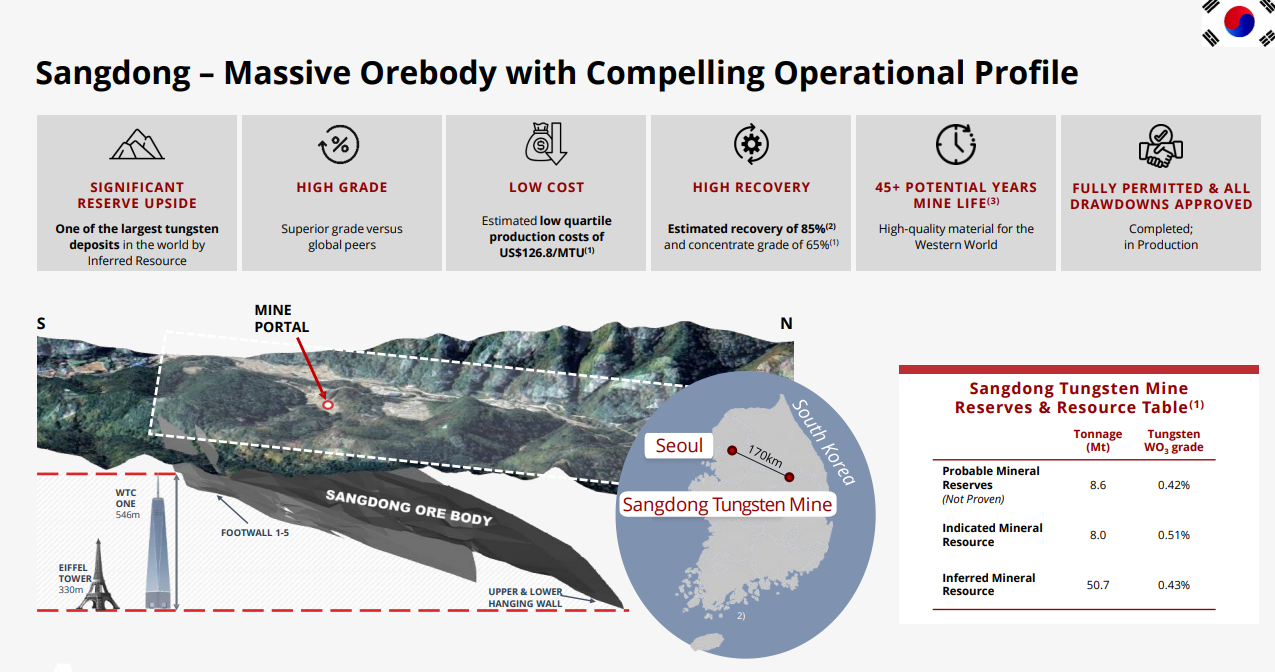
- Low production costs estimated at USD 126.80 per MTU (APT) - Current market price > USD 3,000
- Production in the US: Reactivation of the historic Gentung mine in Montana
- Inclusion of molybdenum as an additional source of cash flow in South Korea
Analysts See the Next Valuation Level
Analysts, too, are increasingly beginning to reflect the new landscape in their models. Cantor Fitzgerald reaffirmed its "Buy" rating and set a price target of USD 25.50. D.A. Davidson goes even further with a target of USD 33, citing the production ramp-up at Sangdong, high tungsten prices, and the additional project pipeline as key reasons for the higher valuation. The underlying production assumptions are particularly interesting. D.A. Davidson expects Almonty's tungsten production, currently around 58,000 MTU from Panasqueira, to rise to more than 300,000 MTU as early as 2026 and climb toward 640,000 MTU in 2027. Based on a more conservative long-term price assumption of USD 1,750 per MTU, revenue of approximately USD 804 million and adjusted EBITDA of nearly USD 700 million are projected for 2027. These are, of course, analyst scenarios and not guaranteed results—but they illustrate the enormous operational leverage of the business model. Rising production is meeting a structurally tight market, while a large portion of the costs is already largely fixed. It is precisely this constellation that can lead to a disproportionately large increase in profitability when tungsten prices are high.
Conclusion: The Tungsten Shortage Is Fueling Almonty's Growth
Almonty Industries is in a completely different position today than it was just a few years ago. Sangdong is entering production, revenues are secured long-term through a 21-year GTP contract, the balance sheet shows more than CAD 1 billion in liquidity, and the project pipeline stretches from South Korea to Portugal to Montana. At the same time, the second quarter—with CAD 43 million in revenue, CAD 17.6 million in adjusted EBITDA, and CAD 31.6 million in operating cash flow for the first half of the year—already demonstrates the momentum possible even before production is fully ramped up.
Particularly exciting is the combination of operational and strategic leverage. Tungsten is one of the few commodities where geopolitics, the defense industry, and technological demand directly intersect with a highly concentrated supply side. Almonty holds its largest assets precisely there—outside of China and with long-term customers from the Western industrial sector.
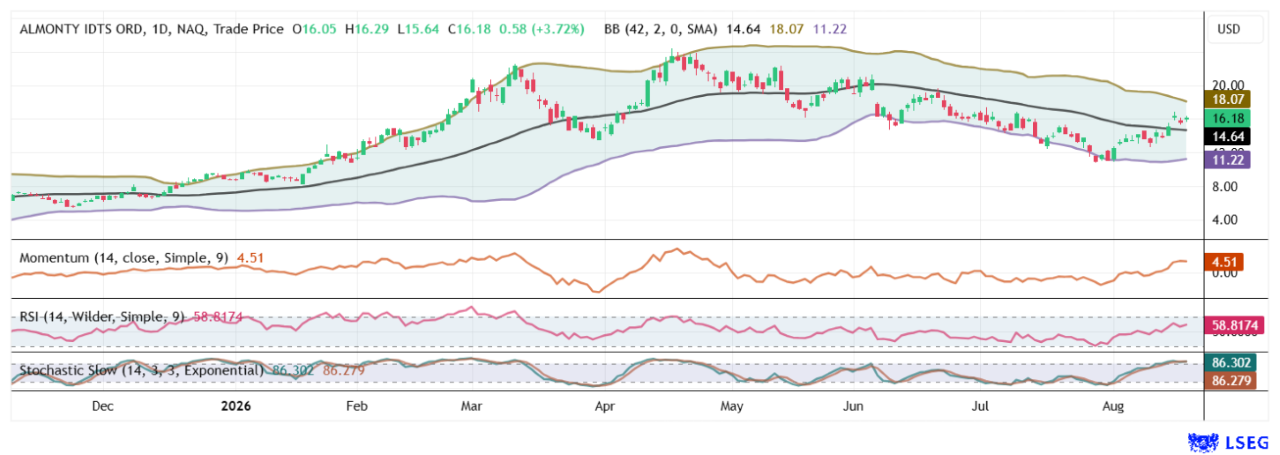
The stock's recent consolidation should not be viewed in isolation. What is far more important is that the fundamentals continued to improve during the price correction: Sangdong is in production, the GTP contract has been significantly expanded, the balance sheet has been strengthened with USD 800 million in fresh capital, the stock has been included in major US indices, and now management itself is signaling—through a potential share buyback of over USD 300 million—that it views the valuation as attractive. This creates a remarkable medium-term starting point.
The stock had reached its previous high of USD 24.40 in mid-April 2026 and subsequently corrected significantly. From a technical analysis perspective, the range between USD 11 and USD 17 formed an important support zone. Almonty is thus no longer just a bet on a new tungsten mine. It is increasingly a bet on who will control the future of Western tungsten supply. In any case, NATO countries make no secret of the fact that the situation today is different from what it was before 2022. Investors should factor this into their investment strategy!
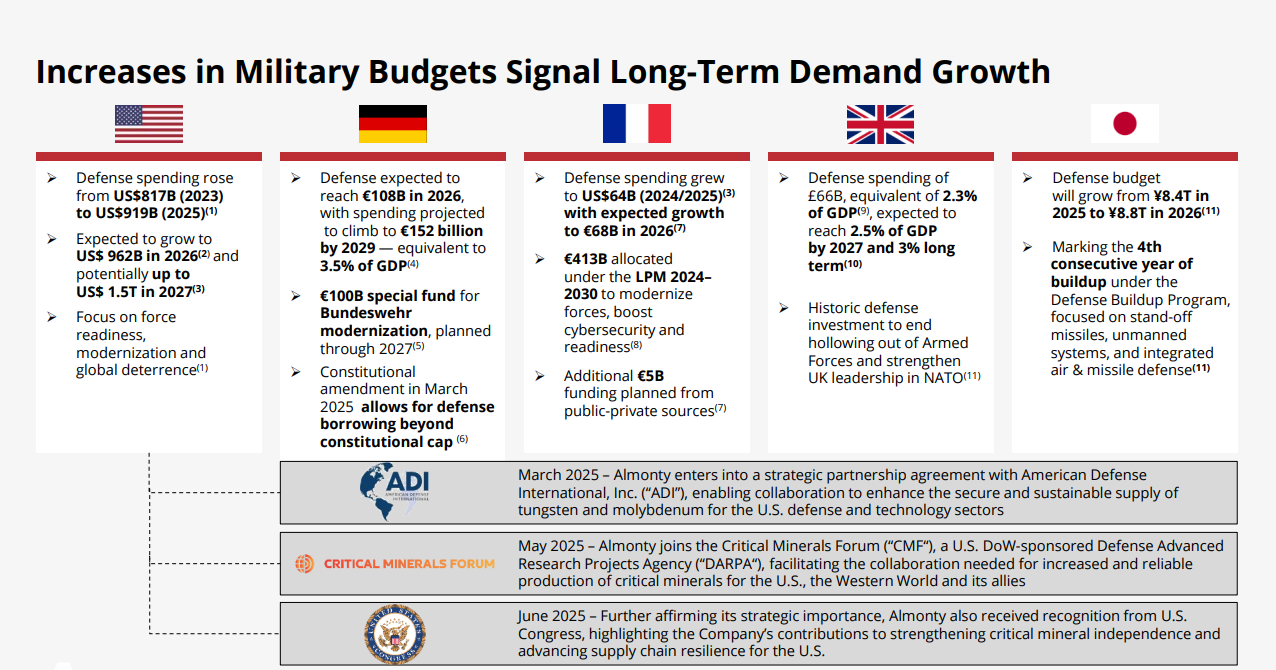
Click here for the latest video featuring CEO Lewis Black and IIF host Lyndsay Malchuk discussing the challenges of building the Western defense line.
This update follows our initial report 12/2021.