Tungsten becomes a geopolitical power factor – China intensifies the shortage
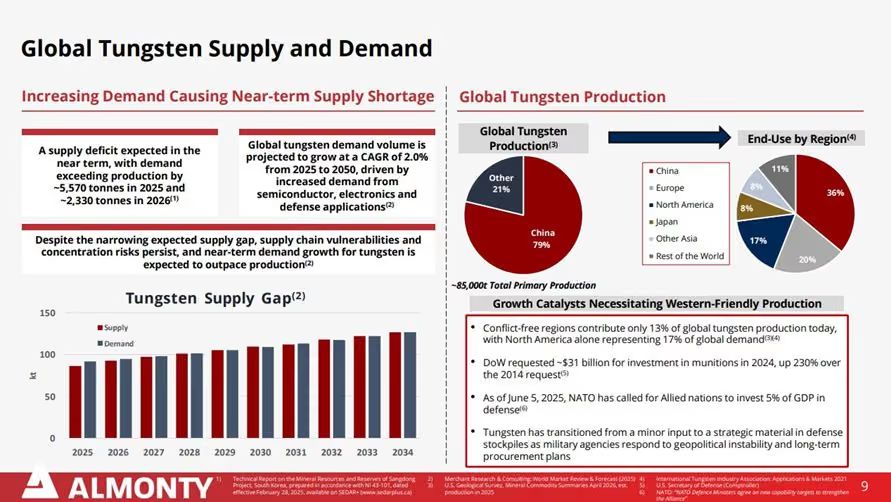
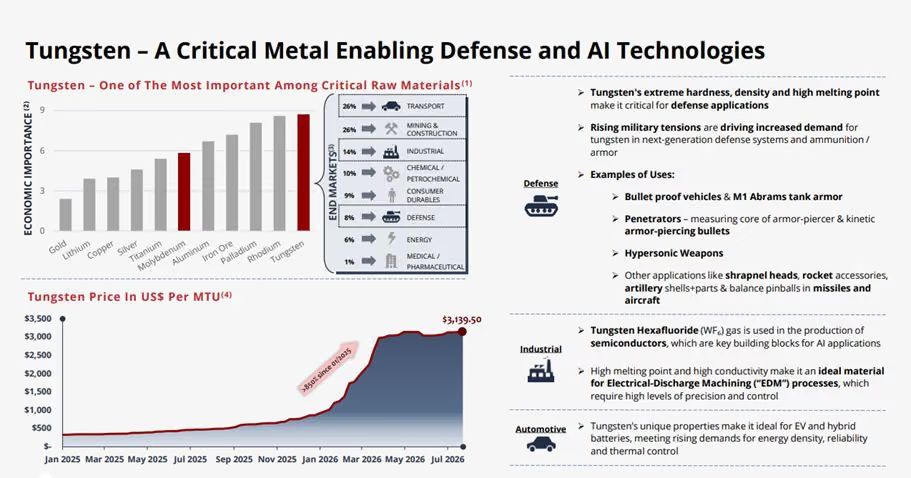
The tungsten market faces a structural realignment that goes far beyond short-term price fluctuations. China controls a large share of global production and is increasingly using its export policy as a strategic instrument. Lower production quotas, a more restrictive licensing system, and the political orientation of raw material supplies have already noticeably changed the international market. In his latest market commentary, Michael Dornhofer, founder of industry specialist ISBP, describes a growing shortage of intermediate products and concentrates. According to his assessment, Western buyers now have to accept APT and tungsten oxide prices of around USD 3,000 per MTU, while price levels in China remain significantly lower. This divide is not a normal market mechanism but is reinforced by export restrictions and geopolitical interests. At the same time, China itself has to source ever more concentrate from abroad: according to Dornhofer's assessment, imports in 2026 have roughly doubled compared with the previous year. This is also putting the Chinese processing industry under increasing supply pressure. This creates a significant strategic advantage for Western producers with reliable supply chains independent of China.
The US draws a clear line – Western producers take centre stage
Political and financial support is becoming a tangible procurement factor. From January 1, 2027, new US restrictions on tungsten from China, Russia, Iran and North Korea will apply to certain military procurement. The regulation explicitly also covers the origin of the ore and feedstock. This is of considerable importance, as the United States currently has no commercial tungsten mines and relied on net imports for more than half of its consumption between 2021 and 2025. According to the US Geological Survey, China accounted for around 67,000 tonnes of an estimated 85,000 tonnes of global mine production in 2025. While numerous North American projects are still at the exploration, study or permitting stage, Almonty is already among the Western producers with active mining operations. A comparison with other US projects also highlights its lead in terms of timing. Although Perpetua Resources secured a USD 40 million funding commitment for studies into potential tungsten extraction in Idaho, it has yet to carry out the relevant work. Other companies are preparing their first drill programmes or are still working on feasibility studies. Almonty, by contrast, can point to existing production in Portugal and the production ramp-up in South Korea. The combination of operational experience, existing facilities and Western-oriented supply capabilities could become the decisive competitive advantage in a market where political origin requirements increasingly determine access to lucrative customers.
Billions in liquidity rather than a capital shortage – Almonty can grow under its own steam
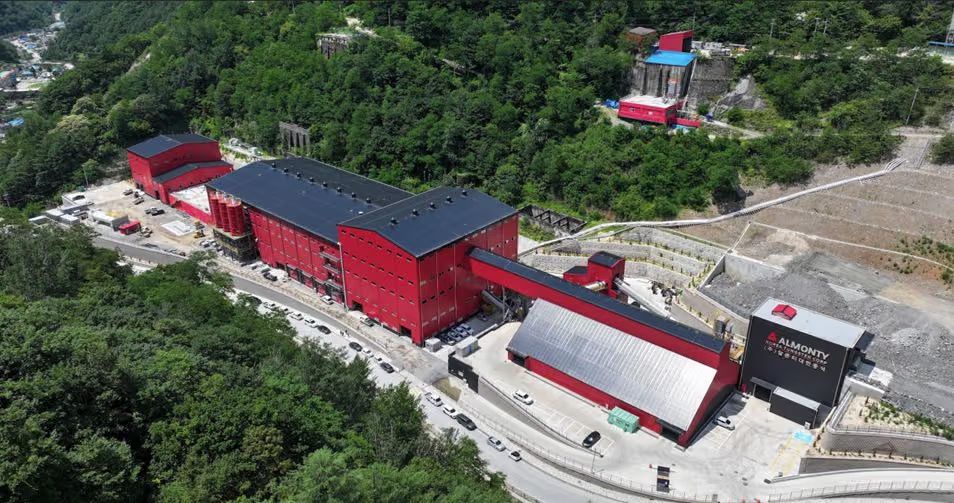
The recent share price decline to around USD 6.30 stands in striking contrast to the company's financial resources. As at September 30, 2026, Almonty held around CAD 1.15 billion in liquid assets. In the third quarter, the group generated revenue of CAD 41.9 million, up 382% from the prior year. Revenue of CAD 43.0 million was generated in the second quarter; to date, revenue has come predominantly from the established Panasqueira mine in Portugal. In his letter to shareholders, CEO Lewis Black emphasises that Sangdong has not yet made a significant revenue contribution and that current developments must therefore not be confused with the full potential of the new Korean site. However, the enormous liquidity reserve fundamentally changes the starting position: Almonty does not have to keep raising fresh equity for its next growth steps and is therefore less dependent on capital-market sentiment. Black sees this as a significant competitive advantage, as many other tungsten projects could come under substantially greater pressure in a more challenging financing environment. The capital is to be invested, among other things, in expanding the Korean operations, tungsten oxide processing, expanding Portuguese production and further projects. For shareholders, the crucial point is that financing the strategic pipeline does not depend directly on another capital increase.
Sangdong approaches continuous operation – the next growth step takes shape
On the operational side, the focus is on the ramp-up phase of the Korean Sangdong mine. In September, tungsten concentrate was produced there for the first time since 1993 – an important milestone in the revival of a historically significant site. In his shareholder letter dated November 22, Lewis Black describes the mine and the grinding circuit as fundamentally operational. The final bottleneck is said to be in the water treatment plant at the end of the production process. A new filter press had already arrived on site and was due to be installed by November 29; the plant is then to be brought into continuous 24-hour operation. At full utilisation, the plant is designed for a throughput of more than 50,000 tonnes per month. In parallel, Almonty is working on the approved second phase of expansion, which is intended to increase processing capacity to up to 1.2 million tonnes annually over the long term. In addition, a tungsten oxide plant is planned in South Korea, which could allow the company to cover a larger part of the value chain itself. Production is also to be developed further in Portugal; CEO Black points to operating margins of more than 60% at Panasqueira. In Montana, meanwhile, work on access to the Gentung project is to begin in the spring, while already prepared stockpiled materials are to be processed. The projects show that Almonty is not relying solely on a single production site, but is building an increasingly integrated Western tungsten business.
New leadership expertise and the Korean capital market – Almonty broadens its base
At the corporate level, structures are being adapted to the group's increased importance. Almonty has appointed two independent directors, Dr Eugene Bae and Jim Rudyk, to its board. Bae brings 25 years of experience in US diplomacy and has served in Seoul, Beijing and New Delhi, among other locations. Most recently, he worked on technology policy, export controls and strategic partnerships at the US Department of State, which is particularly relevant given the importance of South Korea and Western raw material security. Jim Rudyk has more than 35 years of experience in financial leadership, capital market transactions, corporate management and accounting, and most recently served as CFO of Ag Growth International. Following the announced departures of David Hanick and Andrew Frazer at the end of the year, the board is to comprise seven members, including five independent directors.
Almonty plans a secondary listing on the Korea Exchange from 2027. This could enable the company to target Korean investors alongside its existing Nasdaq presence and strengthen its capital market presence in the home country of the Sangdong mine. Completion is not yet certain, however, and depends on review and approval by the exchange and the relevant authorities. Nevertheless, the personnel decisions and the planned listing are more than cosmetic measures: They underline the ambition to prepare Almonty for a significantly larger international role, both organisationally and in the capital markets.
Conclusion: The share price corrects – the strategic position grows stronger
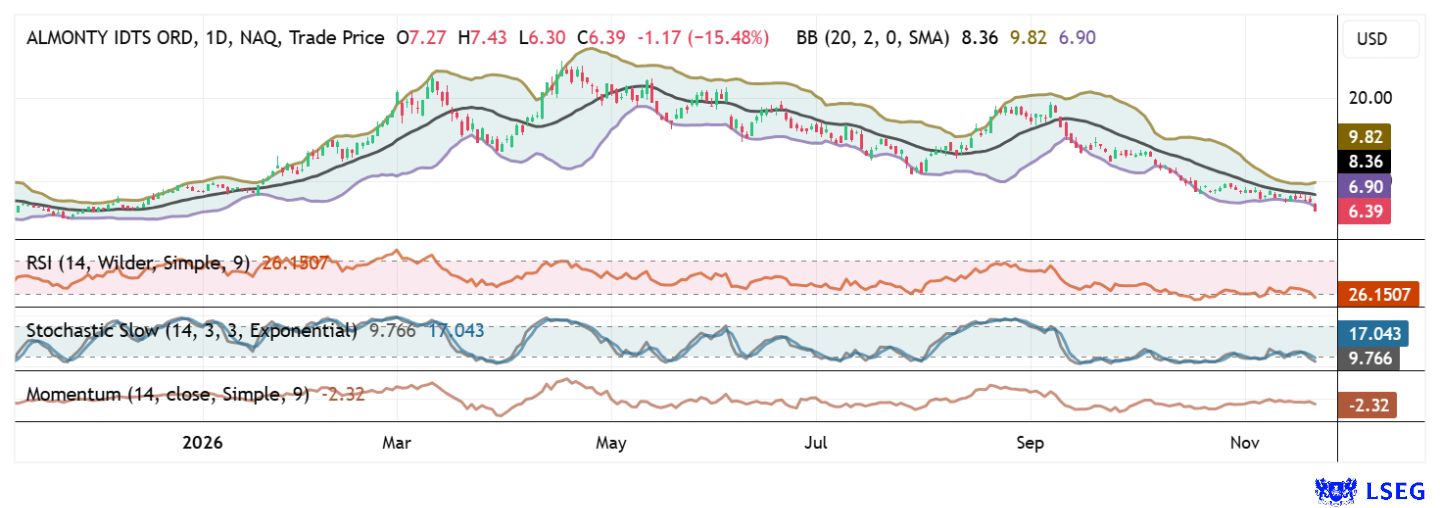
The decline in Almonty's share price to around USD 6.30 on Friday, November 20, 2026, is undoubtedly painful for investors. However, it should not be viewed in isolation, but in relation to the company's operational development and financial starting position. While the stock market is currently marking down many commodity and technology stocks indiscriminately, Almonty has more than USD 1 billion in liquidity, established production in Portugal and a new Korean site that is just entering the crucial ramp-up phase.
If Almonty succeeds in making a swift transition to continuous production at Sangdong, the company can significantly broaden its revenue base and reduce its dependence on Panasqueira. Added to this is a geopolitical environment in which Western buyers are increasingly dependent on suppliers outside China, and US procurement rules could provide additional demand stimulus from 2027.
With his recent share purchases and his clear stance, CEO Lewis Black is signalling that he views the share price decline more as a market distortion. Almonty has established an exceptionally strong financial and strategic starting position. The current valuation could therefore offer an attractive opportunity for long-term, risk-aware investors. The decisive share price driver is likely to be less a further tungsten price rally than proof that Sangdong is producing reliably and that the liquidity base worth billions is being translated into growing earnings. Despite some adjustments to price targets, analysts on the LSEG Refinitiv platform still see an average 12-month potential of USD 20.33. Research firm GBC confirmed its USD 30 price target on November 20. The starting signal for a significant revaluation and recovery should come soon!
Watch the latest video featuring CEO Lewis Black in conversation with IIF presenter Lyndsay Malchuk about the challenges of building the West's defence capabilities.
This update follows our initial Report 12/2021.