
The gold rally continues: Desert Gold focuses on West African deposits
The current geopolitical situation is driving up the gold price and bringing the Canadian explorer Desert Gold (WKN: A14X09 | ISIN: CA25039N4084 | Ticker Symbol: QXR2 | TSX-V: DAU) back into the spotlight. The company is currently evolving from a traditional explorer into a prospective producer with a clearly visible production outlook. At the heart of its operations remains the 440 km² SMSZ project in western Mali, located directly along the Senegal-Mali Shear Zone—one of Africa's most prolific gold corridors. Heavyweights such as Barrick Mining, B2Gold, and Allied Gold operate in the immediate vicinity, impressively underscoring the region's geological significance. The structural continuity appears particularly exciting, as mineralized trends often extend for kilometers beyond the project boundaries. It is precisely here that Desert Gold, with currently around 1.22 million ounces of gold resources, possesses enormous leverage against rising gold prices and potential resource expansions. It is also noteworthy that, to date, only a comparatively small portion of the identified target zones has been systematically explored. That leaves plenty of room for further upside potential.
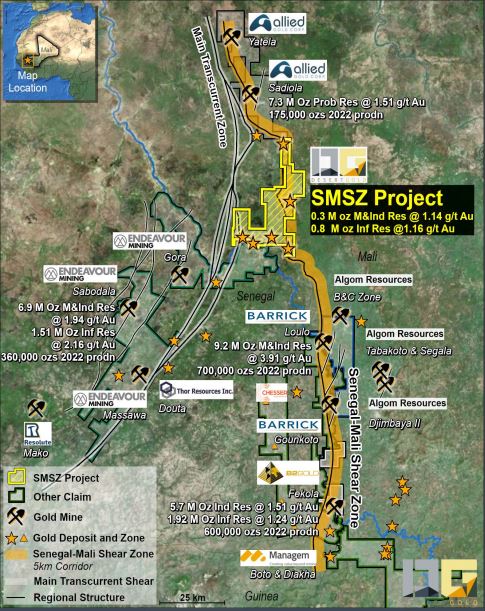
Mali and Côte d'Ivoire: West Africa is emerging as a global gold hotspot
While many investors still view West Africa as a monolithic bloc, the market is increasingly distinguishing between unstable regions and resource-rich emerging economies. Despite geopolitical concerns, Mali remains one of Africa's most significant gold producers and boasts a mining infrastructure established over decades, featuring an experienced workforce and existing transportation routes. At the same time, Côte d'Ivoire opens up a second strategic growth axis for Desert Gold.

The newly acquired Tiegba Gold project covers approximately 297 km² within the highly prospective Birimian Belt, which has already yielded several multi-million-ounce deposits. The geological parallels to well-known districts such as Bonikro or Agbaou lend the area considerable strategic importance. Historical soil samples with anomalies of up to over 200 ppb gold, as well as large structural target zones, suggest that another major exploration project could develop there in the long term. For investors, this creates a rare profile combining short-term production leverage in Mali with long-term discovery upside in Côte d'Ivoire.
At the end of January, CEO Jared Scharf presented his strategy in Côte d'Ivoire in an interview with IIF host Lyndsay Malchuck.
The PEA delivers hard facts: Profitability skyrockets as the gold price rises
The latest economic assessment of the SMSZ project appears particularly noteworthy. The updated PEA for Barani and Gourbassi already shows an after-tax NPV10 of USD 61 million and an IRR of 57% based on a conservative gold price of USD 2,850 per ounce. If the gold price rises to USD 4,070, the project value increases to approximately USD 124 million with an internal rate of return exceeding 100%, according to GBC Research. This leverage is analytically crucial, as a large portion of future operating costs remains relatively fixed, meaning that additional increases in the gold price are reflected almost directly in the margin. At the same time, the study is based primarily on near-surface oxide resources with favourable mining parameters, which keeps potential production costs low. Furthermore, numerous known gold zones have not yet been incorporated into the economic analysis. As a result, the project not only offers operational scalability but also significant valuation potential through future resource expansions. This could be a very exciting fall!
The gravity plant is coming: Desert Gold is visibly shifting into production mode
The key difference from many junior explorers now lies in operational execution. Desert Gold has already successfully completed the technical acceptance of its modular gravity plant with a capacity of 200 tons per day and shipped the equipment from China to Dakar. Six containers, including the generator set, are now on their way to West Africa, while site preparation in Barani East is progressing at a rapid pace. Approximately 52,000 m² of land has already been cleared, initial foundation work is underway, and water development is also making significant progress. The modular approach is particularly beneficial here, as it allows Desert Gold to mitigate traditional development risks and scale production incrementally. According to the company's plans, commissioning is scheduled for mid-July 2026, bringing the first gold production within reach. It is precisely this transition from an explorer to a cash-flow-oriented producer that is likely to fundamentally change the perception of institutional investors in the future.
New drilling programs significantly increase resource potential along the SMSZ
There are even more highlights! Exploration remains highly active in parallel with mine construction. The ongoing Phase 1 RC drilling program, covering 4,250 m, focuses on five key zones, including Gourbassi West North, Mogoyafara South, and Barani Gap. The goal is to extend known gold lenses at depth and along the strike, as well as to define additional near-surface oxide mineralization near the planned infrastructure. Particularly important here is the potential extension of the mine's life, as new resources could be integrated directly into an existing production scenario. Gourbassi West North already has indicated resources of approximately 92,600 ounces of gold, while Mogoyafara South, with about 447,500 ounces, is among the larger target areas. Added to this is Kolon-Soa, a mineralized corridor approximately 8 km long that has seen only limited historical exploration to date. The ongoing drilling could therefore not only increase the total resource but also further enhance the strategic value of the entire SMSZ project.
Desert Gold (WKN: A14X09 | ISIN: CA25039N4084 | Ticker Symbol: QXR2 | TSX-V: DAU)
- PEA for Barani and Gourbassi in Mali shows NPV values exceeding USD 100 million at current gold prices
- Complementary value driver, Côte d'Ivoire is emerging as a leading gold producer in West Africa
- Stable political situation and mining-friendly jurisdiction
- Fast permitting, good infrastructure, and dynamic national development
- Underexplored areas offer high exploration potential and strategic opportunities
- Tier-1 producers and neighbours such as Barrick Mining, Endeavour Mining, Allied Gold, and Perseus Mining are seeking to steadily increase their indicated ounce reserves
- Proximity to multi-million-ounce deposits, such as Agbaou (Allied Gold Corp), Bonikro/Hire (Allied Gold Corp), and Yaouré (Perseus Mining Ltd), creates M&A potential
CONCLUSION: GBC sees CAD 0.93 – Significantly ndervalued with over 500% upside potential
With two promising West African projects, growing resource momentum, and the prospect of its first operational cash flow, Desert Gold is increasingly coming into the focus of larger, and perhaps strategic, gold investors. Following its latest financing round, the company has a solid capital base with approximately 360 million outstanding shares, allowing it to implement the next development steps without immediate financing pressure. In early May, the stock hit a new three-year high of CAD 0.145, accompanied by exceptionally high trading volumes, at times exceeding 7 million shares per day. Particularly relevant from a technical analysis perspective: the persistent resistance in the CAD 0.12 range, where large volumes had previously weighed on the market for months, was decisively broken. After years of groundwork, the image of a classic nano-cap is increasingly shifting toward that of a serious micro-cap with a market capitalization now exceeding CAD 50 million—a scale that, based on experience, is also increasingly attracting institutional commodity investors.
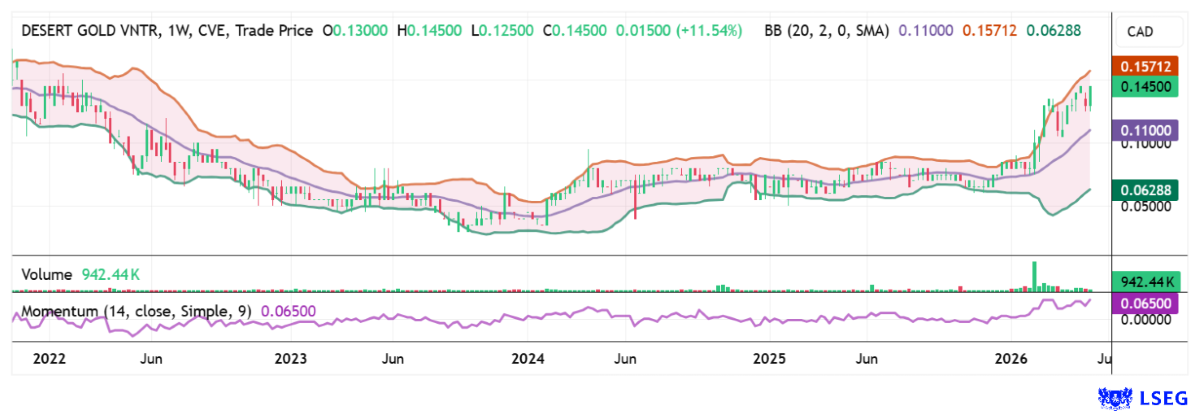
Fundamentally, this development receives additional tailwind from the updated PEA for the SMSZ project, whose sensitivity analyses very quickly reach project values well above USD 100 million at higher gold prices. At the same time, the ongoing construction of the modular gravity plant significantly reduces the typical explorer risk, as Desert Gold is thereby visibly entering the transition phase to becoming a producer. It is precisely this operational shift that is likely to become the central component of the revaluation in the coming quarters. The research firm GBC AG now values the stock's fair value at CAD 0.93, citing the combination of short-term production leverage, significant exploration potential, and growing strategic attractiveness within the Senegal-Mali Shear Zone. Should Desert Gold achieve the announced milestones regarding plant installation, initial gold production, and resource expansion as planned, the stock could continue its upward trend with significantly increased momentum. A buy near the breakout range of CAD 0.14 to 0.16 makes sense!
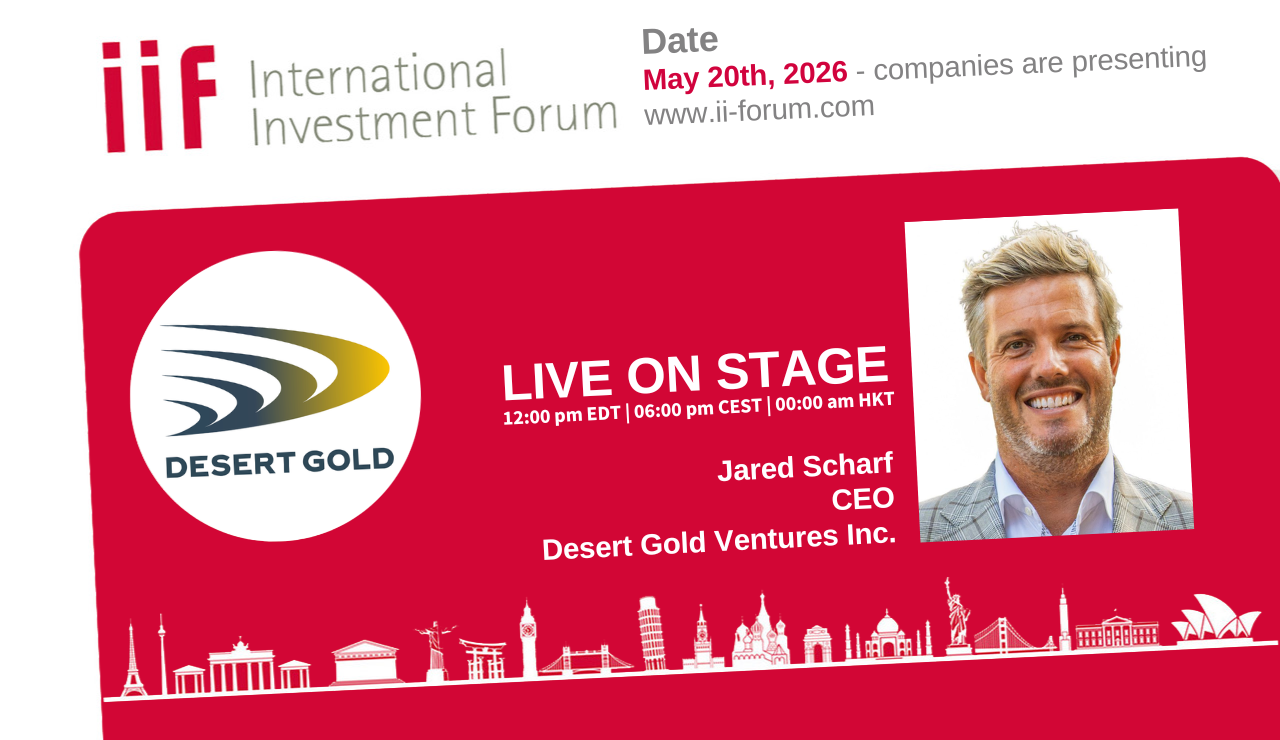
CEO Jared Scharf will present live to investors on May 20 as part of the 19th International Investment Forum. The update on the latest developments is expected to be highly interesting. Click here to register.
This update follows our initial Report from 11/21.