
Heartbeat of the Gold Boom: Situated in West Africa’s Most Productive Gold Corridor
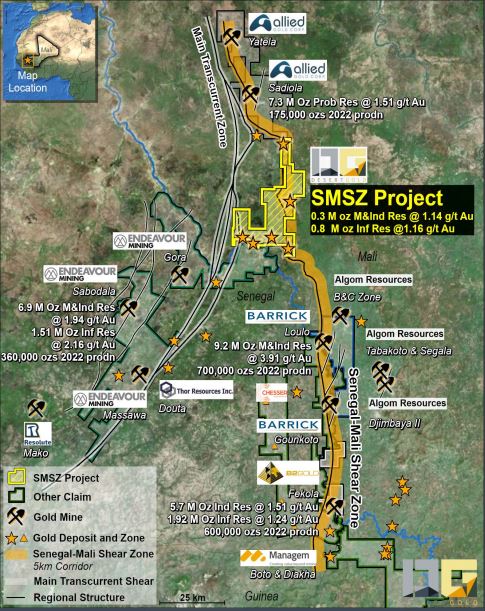
The news for Canadian explorer Desert Gold (WKN: A14X09 | ISIN: CA25039N4084 | Ticker symbol: QXR2 | TSX-V: DAU) could not be better at the moment. The successful explorer operates in one of the few regions in the world where geology, history, and infrastructure form an almost ideal intersection: the Senegal-Mali Shear Zone (SMSZ). Over the past decades, this structural corridor has produced deposits containing several million ounces and has attracted well-known mining giants such as Barrick Mining, B2Gold, and Allied Gold. The small Desert Gold controls around 440 km² of contiguous land here today, a strategic asset between active large-scale mines. Crucial from an analytical perspective: the gold-bearing structures are continuous throughout the region. The probability that mineralized trends will continue beyond the license boundaries is high and impressively demonstrated by neighboring mines.
From Explorer to Developer: 2026 Marks an Operational Turning Point
2026 is not a year of announcements, but of implementation. While many junior companies are still modeling resources, Desert Gold is already investing in physical infrastructure. Roads, foundations, water wells, ROM pads, and environmental structures are being prepared at the fully approved Barani East project. At the same time, a modular processing plant is being built, which should be operational by the middle of the year. From an analytical perspective, this approach significantly reduces project risk. Upfront investments shorten construction time, reduce CAPEX peaks, and increase the predictability of the transition to production.
Drilling Results from Mali: Resource Size, Geology, and Upside Inspire
The SMSZ project currently has a resource of approximately 1.1 million ounces of gold with average grades of approximately 1.1–1.2 g/t. However, it is not only the absolute size that is remarkable, but also the composition: these are predominantly near-surface oxide resources with favorable geology. Of the more than 30 gold zones identified, only five have been included in the resource estimate to date. In purely statistical terms, this means there is considerable potential for expansion. Each additional zone that is newly developed and has similar parameters can significantly increase the resource without causing a proportional increase in infrastructure costs – a classic lever on the project value. Based on these assumptions, the pre-feasibility study prepared in 2025 contains significant upside potential.
The PEA in Figures: Profitability with a Buffer
The updated preliminary economic assessment (PEA) provides hard facts. Assuming a gold price of around USD 3,000 per ounce, the project has an internal rate of return (IRR) of approximately 57%. The net present value (NPV 10%) after taxes is over USD 61 million. By comparison, the current market capitalization is significantly lower at CAD 36 million. Sensitivity is particularly relevant: the gold price is currently trading at a further USD 1,500 to 2,000 above the calculation basis, which means that the NPV increases disproportionately, as a large part of the costs are fixed. With gold prices of approximately USD 5,000 and above, the project's net present value is well over USD 100 million. Metallurgical test work confirms recovery rates of around 68% using pure gravity, and a subsequent CIL step could increase this to over 90%. This implies additional upside without adding new resources. All signs point toward a very promising surge!
Second Growth Axis: Tiegba as a Strategic Option in Côte d'Ivoire
The Tiegba project adds a second, analytically defined value driver. The concession area covers approximately 297 km², of which less than 20% has been systematically explored to date. Historical soil samples yielded values between 50 and over 200 ppb gold along a 4.2 km x 2.1 km anomalous trend. No drilling results are available yet – which makes this asset particularly attractive: high exploration potential with limited risk, as its intrinsic value is already supported by SMSZ.
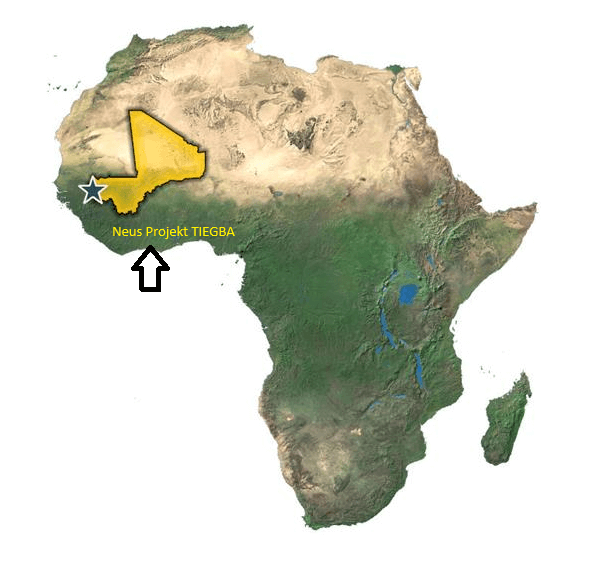
The Tiegba project lies within the Paleoproterozoic Birimian Terrane, which manifests itself in a northeast-trending volcanic-sedimentary sequence with syn- to late-tectonic granitoids, typical of gold-bearing greenstone belts in West Africa. The local geology of the project bears strong similarities to the Bonikro-Agbaou gold district. Notably, calc-alkaline intrusive structures have been mapped along the eastern and western margins of the permit area. These intrusions are considered favorable host rocks for gold mineralization, particularly along their contacts with highly stressed structural corridors and at the intersection with quartz vein networks. These geological structures are top-priority targets for further exploration.
At the end of January, CEO Jared Scharf presented his strategy in Côte d'Ivoire in an interview with IIF host Lyndsay Malchuck. Click here to watch the video.
Financial Clout: February Financing Secures Next Steps
The CAD 7.18 million financing completed in February strengthens the balance sheet at a critical stage. The high demand and the increase in the round indicate strong institutional interest. Analytically important: the funds are sufficient to cover infrastructure, equipment, and next development steps without having to return to the capital market in the short term. This reduces the risk of dilution precisely at a time when important operational milestones are imminent.
On the sidelines of the recent Mining INDABA conference in Cape Town, CEO Jared Scharf said: "The coffers are now sufficiently full, let's build a mine!" – and he really means it.
Asymmetric Opportunity: Revaluation Backed by Figures
If one compares the PEA NPV of over USD 60 million with the current stock market valuation, the result is a significant undervaluation – even without resource expansions or higher gold prices. Adding the upside from previously unconsidered zones and the exploration option in Côte d'Ivoire creates an asymmetric opportunity profile. Whether Desert Gold goes into production itself or serves as a takeover target is secondary from an investor's perspective. In the gold sector, ounces "in the ground" are currently valued at only around USD 50 to 150 per ounce on average by explorers, depending on project status, geology, and location. This is precisely where the valuation discrepancy arises with Desert Gold Ventures, whose SMSZ project already has more than 1.1 million ounces of gold in all resource categories, of which only a fraction has been economically modeled to date. Even with a conservative approach at the lower end of the peer valuation, this implies a project value that is significantly above the current market capitalization. The current PEA significantly reduces the classic explorer risk, as it already demonstrates economic viability, metallurgy, and low capital costs, marking the transition from a pure resource holder to a development project. In an environment of rising gold prices and increasing acquisitions, producers are no longer paying for theory, but for scalable, validated ounces – precisely the category into which Desert Gold is increasingly growing.
Desert Gold (WKN: A14X09 | ISIN: CA25039N4084 | Ticker symbol: QXR2 | TSX-V: DAU)
- PEA for Barani and Gourbassi in Mali shows NPV values in excess of USD 100 million at gold prices of around USD 5,000
- Complementary value driver, Côte d'Ivoire presents itself as an emerging gold producer in West Africa
- Stable political situation and mining-friendly jurisdiction
- Fast approvals, good infrastructure, and dynamic country development
- Underexplored areas offer high exploration potential and strategic opportunities
- Significant interest from Tier 1 producers such as Barrick Mining, Endeavour Mining, Allied Gold, and Perseus Mining
- Location near multi-million ounce deposits such as Agbaou (Allied Gold Corp), Bonikro/Hire (Allied Gold Corp), and Yaouré (Perseus Mining Ltd)
CONCLUSION: GBC sees CAD 0.81 – Dramatically Undervalued with 800% Potential
The gold market has entered a revaluation phase since the beginning of 2026. The recent consolidation in the range of USD 4,800 to 5,200 also came to a quick end. While large mining companies are able to realize dream margins in the current spot market compared to their costs, promising explorers are also attracting increased attention from savvy investors. This is because, with metal prices remaining high, Tier 1 producers can quickly invest their cash flow in strategic mine expansions. According to consensus analyses, major investment houses see gold trading predominantly in the range of USD 4,400 to USD 6,300 per ounce by the end of 2026, with the highest forecast targets from JPMorgan at around USD 6,300/ounce, followed by UBS at around USD 6,200 and Deutsche Bank and Société Générale at USD 6,000 each.
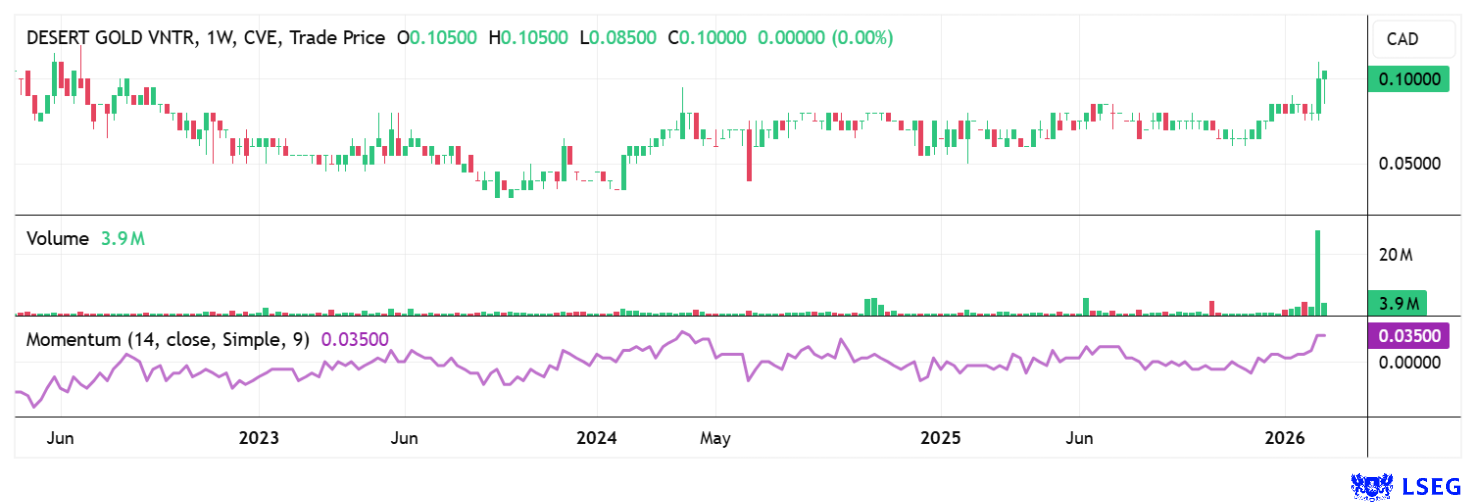
Desert Gold is now in the spotlight with two properties, the prospect of a significant resource expansion, and the start of small-scale production. With approximately 360 million shares after the latest financing, the coffers are full. In early February, Desert Gold reached a new three-year high at CAD 0.11. Over 10 million shares changed hands in some sessions. This also broke the multi-month resistance at CAD 0.08, which had proven quite stubborn since the last financings.
Nevertheless, the market capitalization has only risen to around CAD 36 million in recent days. With a fresh PEA behind it, which in the sensitivity analysis quickly points to a three-digit valuation beyond USD 100 million, the DAU share should continue its positive trend rapidly. The research firm GBC already estimated the fair price per share at CAD 0.81 back in October. Now the path seems clear to new highs, and purely from the perspective of high momentum, the stock could multiply very quickly.
CEO Jared Scharf will present live at 6:30 p.m. CET on February 25, 2026, as part of the 18th International Investment Forum. The update on the latest developments is likely to be exciting. Click here to register

This update follows our initial report 11/21.