
Québec as a Geopolitical Commodity Hub: Strategic Resources at the Center of the Critical Metals Landscape
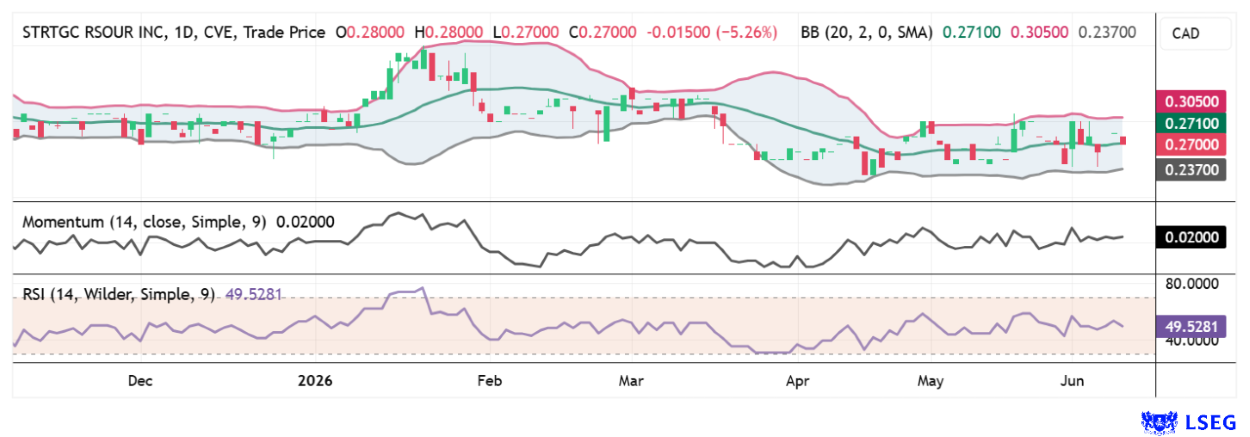
Québec ranks among the world's leading mining jurisdictions, with over 900 active exploration and mining companies and a strong industrial base that directly and indirectly supports more than 65,000 jobs. The region combines political stability, low energy costs thanks to nearly 100% hydroelectric power availability, and an exceptionally well-developed logistics infrastructure with deep-water ports, rail, and pipeline connections. For Strategic Resources (CAD 0.27 | TSX-V: SR | WKN: A2AP0B | ISIN: CA86277X3004), this results in a location that is not only geologically attractive but, above all, industrially scalable. Secure integration into an ecosystem strongly focused on decarbonization and critical raw materials increases the structural demand for projects like BlackRock. Québec, for its part, is doing everything it can to become a central pillar of North American raw material sovereignty, particularly in competition with China for vanadium and steel precursors. This combination of infrastructure, energy price advantages, and political support creates a framework in which large-scale industrial projects become realistically financeable.
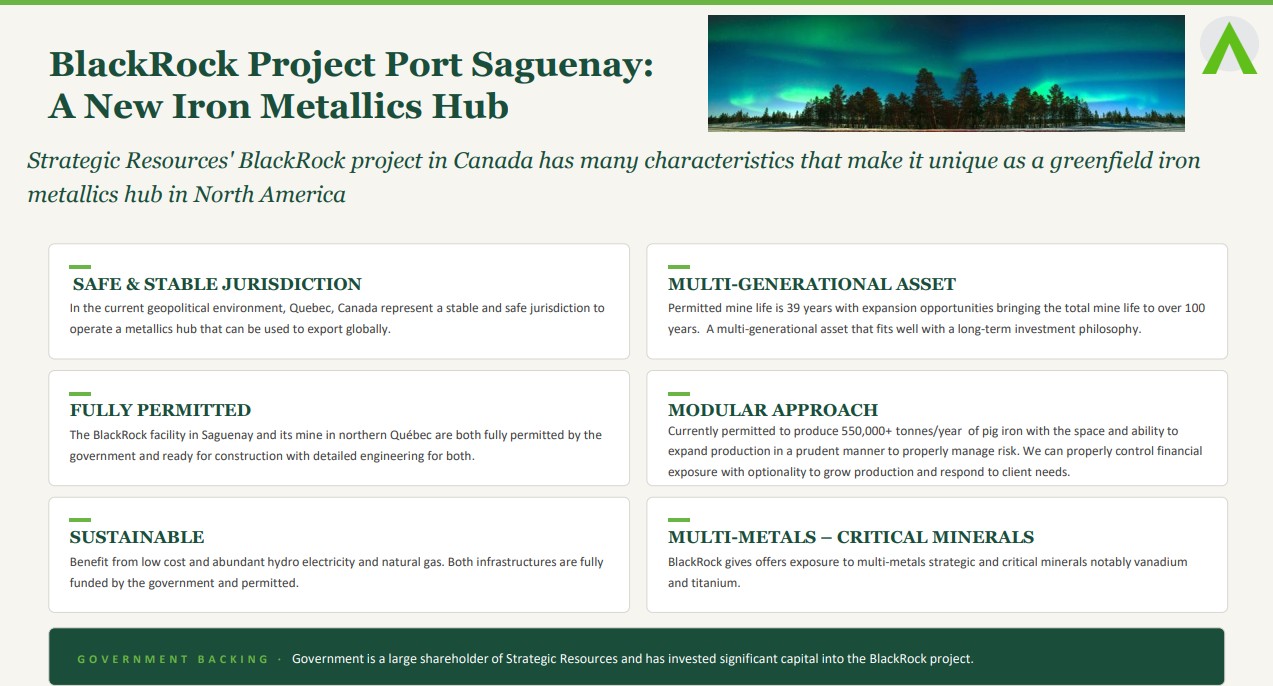
BlackRock Project: Multi-Metal Asset with 128 Million Tonnes of Resources and Industrial Depth
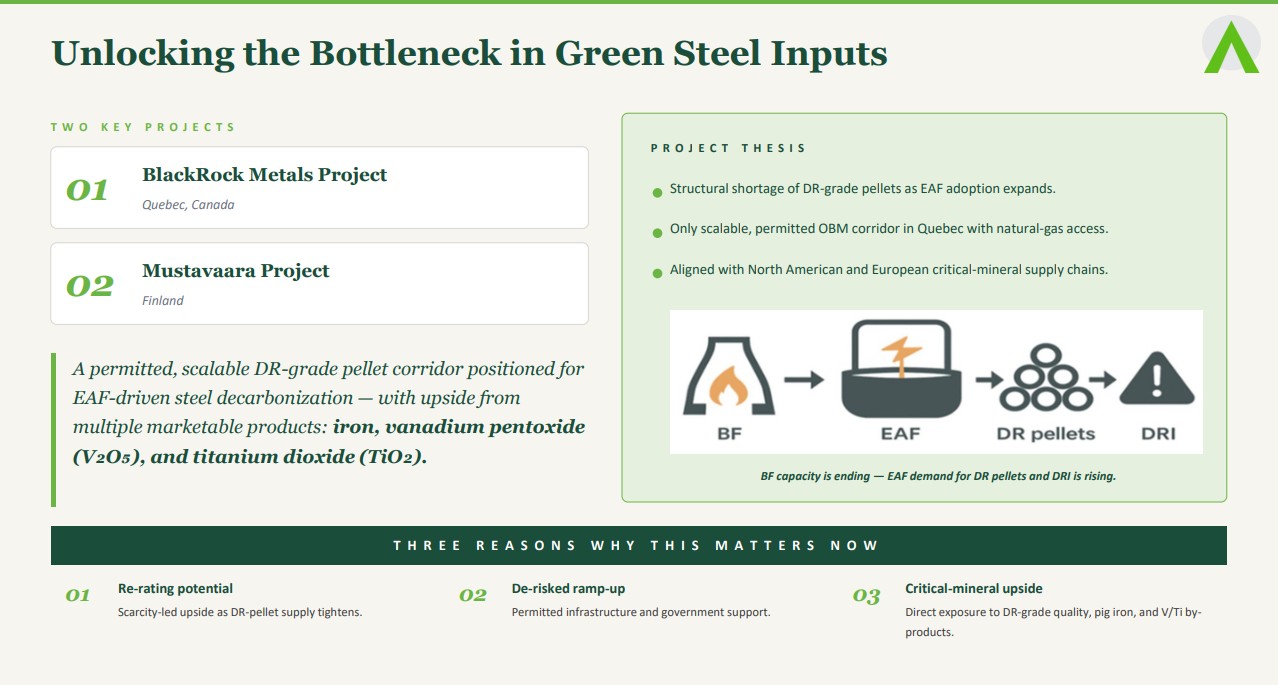
The BlackRock Project comprises approximately 128 million tonnes of mineralized reserves with a rare combination of iron oxide, vanadium, and titanium, addressing multiple industrial end markets simultaneously. Plans call for a pelletizing plant in the Port of Saguenay with an annual capacity of 4 million tonnes, supplying DR-grade pellets for electric arc furnaces.
"A multi-deposit for critical metals."
This technology is a key component of global steel decarbonization, as it produces significantly lower CO₂ emissions than traditional blast furnaces. Production costs are around USD 16.31 per tonne, while high-quality pellets can fetch up to USD 175 per tonne on the market; from today's perspective, the margin is a dream. The site also offers access to deep-sea port infrastructure and affordable hydropower, which structurally reduces both energy and transportation costs. As a result, BlackRock is evolving from a traditional mining project into an integrated raw materials and industrial hub with direct links to global steel supply chains.
Integrated Value Creation & Battery Synergies: Vanadium as a Strategic Second Platform
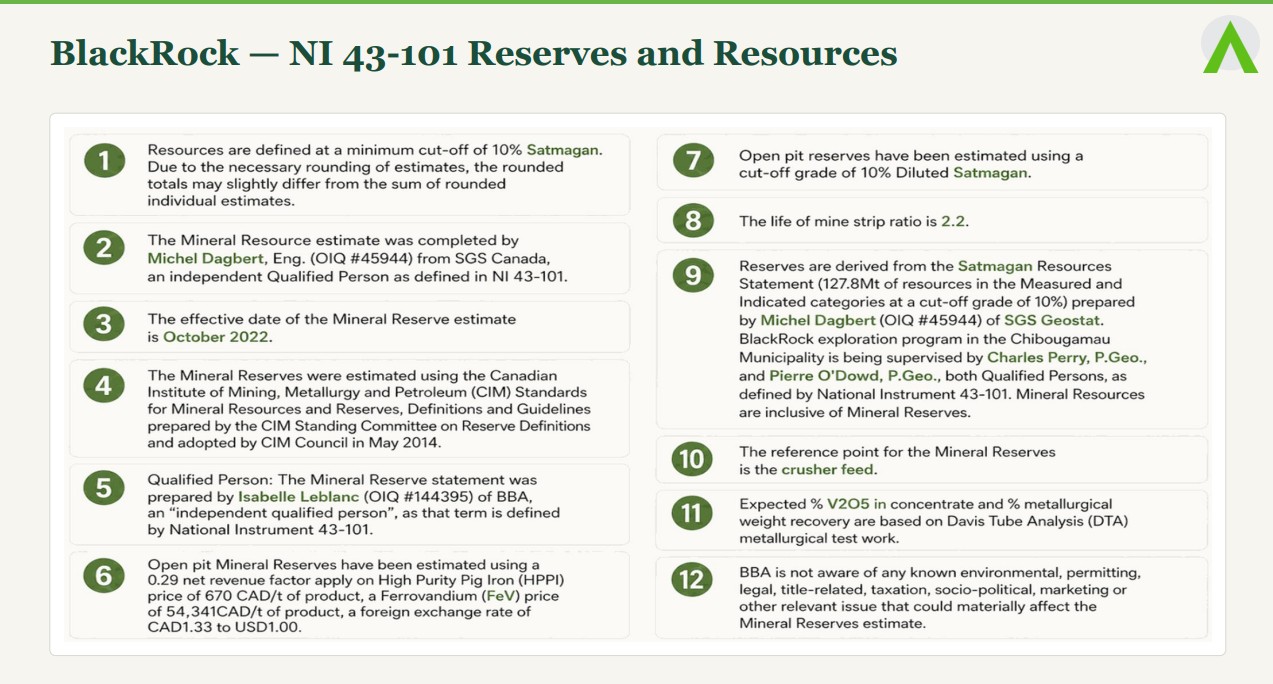
In addition to steel value creation, Strategic Resources is establishing a second industrial focus in the field of energy storage. As part of the cooperation with Tyfast Energy, vanadium oxide from Québec is converted into lithium-vanadium oxide anodes designed for high-performance batteries. This technology is particularly attractive for high-demand applications such as mining equipment, military vehicles, and off-road systems, as it combines high cycle stability, fast charging capability, and cold resistance. The strategic value lies less in the volume market than in highly specialized niches with high barriers to entry. This expands the business model from a pure raw material supplier to a potential supplier of materials for specialized energy systems. This development significantly increases the company's long-term opportunities, but remains in the early validation stage.
Hydrogen as a Strategic Option: A Look Ahead to the Next Stage of Steel Decarbonization
An additional future path, one that has so far been developed more indirectly, lies in the potential hydrogen economy, which can be derived in particular from the company's positioning in Québec. Thanks to its extremely affordable hydropower, the region offers ideal conditions for the production of "green hydrogen," which could potentially be used as a reducing agent in the steel industry and thus partially replace traditional coking processes.
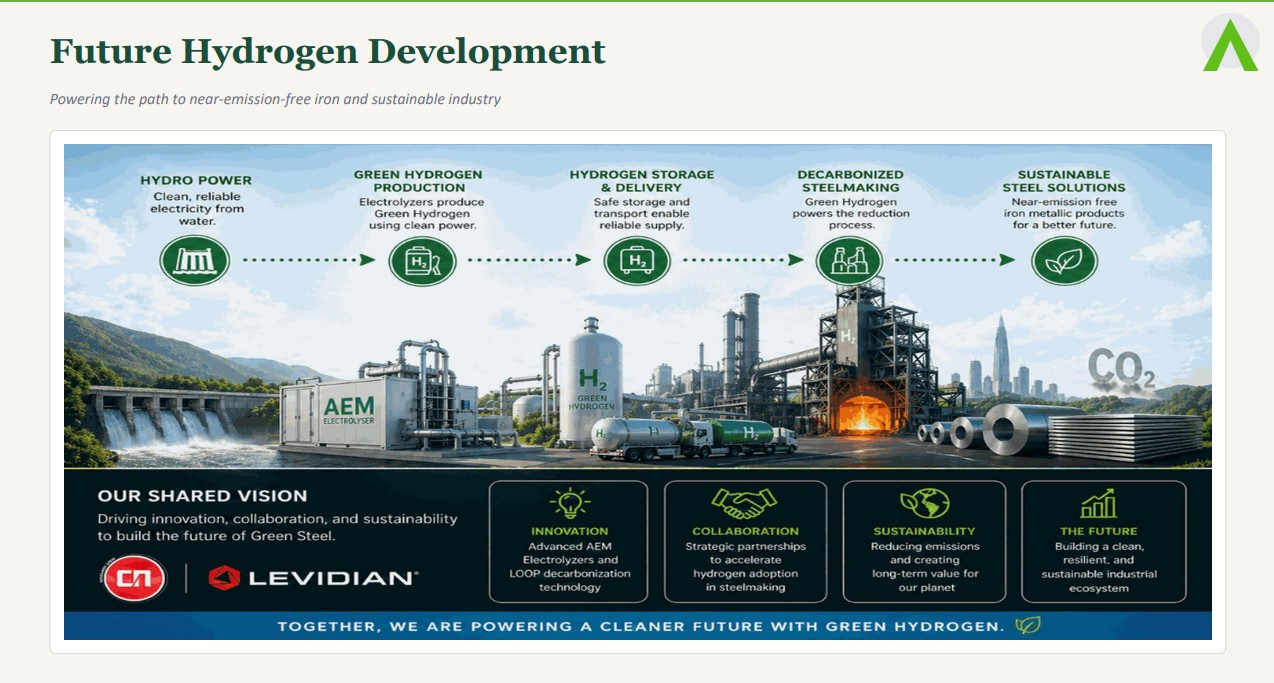
"Strategic Resources also holds a wildcard in the hydrogen sector. Who knows when this theme will truly take off! Source: Strategic Resources Corporate Presentation, May 2026."
For Strategic Resources, this creates a long-term optional interface, as the planned pellet production for electric arc furnaces could, in principle, be integrated into a hydrogen-based direct reduction (DRI) system. Should this technological shift in the steel sector accelerate, DR-grade pellets from BlackRock would remain strategically relevant not only for EAF applications but also for hydrogen-based direct reduction plants. In combination with the existing vanadium and titanium value chains, this creates a theoretically expandable industrial concept that is decoupled from traditional raw material cycles and more closely linked to the transition toward CO₂-free heavy industry. This hydrogen option has not yet been operationalized, but it significantly increases the site's long-term structural relevance.
The European Option: Mustavaara in Finland and Global Vanadium Positioning
A key additional strategic asset is the Mustavaara mine in northern Finland, which historically accounted for around 10% of global vanadium production and has proven resources of approximately 104 million tons. The project was previously in operation but is currently dormant and could be reactivated if European demand rises. An earlier economic assessment indicated a potential after-tax NPV of approximately EUR 190 million.
However, its location within the Eurozone is key. Mustavaara is gaining significance in the context of European raw materials policy, as the EU aims to significantly reduce its dependence on Chinese vanadium supply chains through the "Critical Raw Materials Act." Strategically, this creates a second foothold outside of Canada, enabling smart geopolitical diversification. In combination with BlackRock, this could create a transatlantic vanadium platform in the long term that addresses both industrial and security-related demand.
Capital Structure, Government Influence, and Financing Leverage: Strong De-Risking Amid High Capital Intensity
The shareholder structure is exceptionally concentrated, as Orion Mine Finance and Investissement Québec each hold approximately 41% of the shares, thereby providing both financial and political backing. In total, infrastructure investments exceeding CAD 280 million are publicly supported, including facilities, warehouses, and logistics systems in the Port Saguenay area. A long-term supply agreement with Javelin Global Commodities includes committed working capital financing of approximately USD 150 million, which makes the commercial foundation look very strong so far.
A capital increase of up to CAD 10 million has been underway since the end of May 2026, intended to secure short-term project development and the next steps in 2026. Despite these strong partners, the capital requirements for implementing the large-scale facility remain substantial, particularly with regard to potential project financing in the range of several hundred million USD. The existing structure reduces traditional exploration risks but shifts the focus entirely to future financing and implementation risks. However, CEO Sean Cleary makes it clear in all presentations that he is serious about bringing this project to fruition!
Investment Highlights
Strategic Resources (CAD 0.27 | TSX-V: SR | WKN: A2AP0B | ISIN: CA86277X3004)
- Québec is emerging as a key location for Western raw material security
- The BlackRock project combines iron, vanadium, and titanium in a rare multi-metal deposit
- Planned production of 4 million tons of DR-grade pellets addresses the structurally growing market for green steel
- Strategic location at the deep-water port of Port Saguenay combines logistical advantages with affordable hydroelectric power from Québec
- Fully permitted project and financing commitments significantly reduce development risks
- Vanadium expertise opens access to battery, defence, and high-performance applications
- Partnership with Tyfast Energy opens up the North American value chain for battery materials
- Infrastructure investments of several hundred million CAD strengthen economic viability
- Long-term trend toward decarbonization increases demand for high-quality iron ore pellets for electric arc furnaces
- Mustavaara in Finland offers additional vanadium potential and creates a strategic bridge to the European market
- Hydrogen-compatible direct reduction processes could further increase the importance of high-quality DR pellets in the long term
- A market capitalization of only around CAD 16.5 million contrasts with a project with a potential value in the billions and creates significant revaluation potential upon successful implementation
Outlook & Investment Case: Valuation Gap Between Reality and Industrial Potential
The current market capitalization of approximately CAD 16.5 million contrasts with a potential project value of up to CAD 2 billion, based on previous feasibility studies with expected returns exceeding 18%. This extreme discrepancy forms the central lever for an investment case that fits perfectly into the current scarcity scenario facing Western industries. Currently, the overall project is still entirely dependent on the successful securing of financing and the construction of the infrastructure. Discussions regarding this major undertaking have been very encouraging so far.
The transformation from a development project to an operational producer with integrated pellet and material processing will be crucial. At the same time, the combination of green steel, vanadium battery technology, and optional European production in Finland opens up a rare multi-sector platform. While proximity to government actors reduces political risks, it also raises expectations for rapid implementation progress. For investors, entering at this current development stage is highly attractive, as valuations have not yet risen. Take advantage of the capital market correction and buy at a bargain price!
IIF host Lyndsay Malchuk in conversation with CEO Sean Cleary about the upcoming construction of the extraction facility in Québec.